
HMS Calcutta
1918 C-class light cruiser
Vessel Wikidata
* This information from Wikidata is available under the Creative Commons Attribution-ShareAlike License
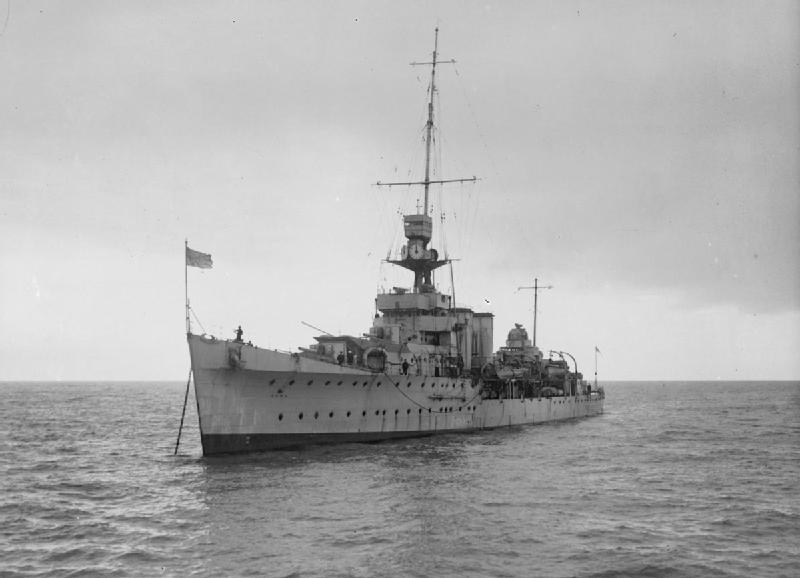
HMS Calcutta was a C-class light cruiser of the Royal Navy, constructed by Vickers Limited at Barrow-in-Furness. Laid down on 28 January 1917 and launched on 9 July 1918, she was completed in August 1919. The vessel measured approximately 451.5 feet (137.62 meters) in overall length, with a beam of 43 feet 6 inches (13.26 meters) and a draught of 14 feet 3 inches (4.34 meters). Displacing 4,290 long tons (4,360 tonnes) at normal load and up to 5,250 long tons (5,330 tonnes) at deep load, Calcutta was powered by six Yarrow boilers feeding two Parsons geared steam turbines rated at 40,000 shaft horsepower, enabling her to reach a top speed of 29 knots (54 km/h). Her armament as built included five single-mounted BL 6-inch Mk XII naval guns, two QF 3-inch 20 cwt anti-aircraft guns, two 2-pounder pom-poms, and eight 21-inch torpedo tubes arranged in four twin mounts. The ship's armor consisted of a 3-inch (76 mm) belt amidships, tapering to 1.5 inches (38 mm) forward and 2 inches (51 mm) aft, with a 1-inch (25 mm) armored deck protecting her machinery compartment. Originally serving on the North America and West Indies Station, HMS Calcutta was flagship of the 8th Light Cruiser Squadron, based at Bermuda, and participated in various operations, including putting down violence during a general strike in Trinidad and Tobago in December 1919. She sustained structural damage during the 1926 Havana–Bermuda hurricane when she was dashed against a jetty. Later, she served as flagship of the 6th Cruiser Squadron on the Africa Station until 1931, after which she was placed in reserve. In 1938, Calcutta was converted into an anti-aircraft cruiser at Chatham Dockyard, replacing her original armament with eight 4-inch Mk XVI guns in four twin mounts, along with enhanced close-in anti-aircraft weaponry. She returned to active service with the Home Fleet in August 1939, primarily escorting convoys and participating in operations during the Norwegian Campaign and the Dunkirk evacuation in 1940. Notably, Calcutta evacuated thousands of troops from Dunkirk, operating off La Panne and Dunkirk itself, despite sustaining near-misses from German bombs. Calcutta was involved in numerous Mediterranean operations, including escorting convoys to Malta and participating in the Battle of Crete. On 1 June 1941, while escorting a convoy near Alexandria, Egypt, she was attacked by German aircraft and sunk. Her loss resulted in the deaths of 107 men, with 255 survivors rescued by other Royal Navy vessels. HMS Calcutta's service record reflects her significant role in both World Wars and her contribution to maritime operations in the Mediterranean and Atlantic theaters.
This description has been generated using GPT-4.1-NANO based on the Vessel's wikidata information and then modified by ShipIndex.org staff.