
HMS Viking
1909 Tribal-class destroyer
Vessel Wikidata
* This information from Wikidata is available under the Creative Commons Attribution-ShareAlike License
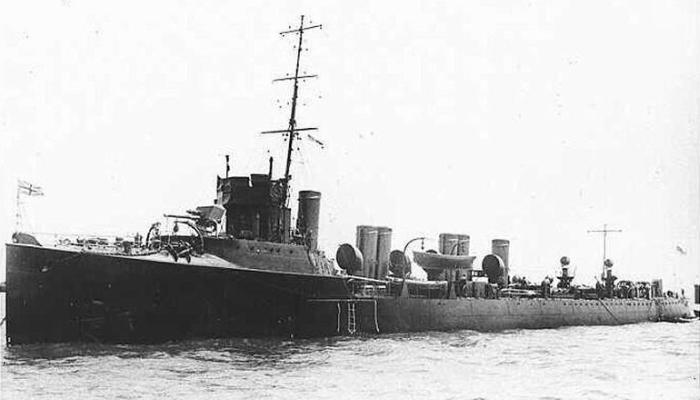
HMS Viking was a Tribal-class destroyer of the Royal Navy, launched in 1909 and decommissioned and sold for scrap in 1919. Notably, she was the only destroyer in her class to feature six funnels, a distinctive visual characteristic. Built at Palmers' Jarrow shipyard, Viking was laid down on June 11, 1908, and launched on September 14, 1909. She measured approximately 290 feet 3 inches in overall length, with a length between perpendiculars of 280 feet 2¾ inches. Her beam was 27 feet 5 inches, and she had a draught of 9 feet 9 inches. Displacing around 1,090 long tons normally and up to 1,210 long tons at full load, Viking had a turtleback forecastle topped by a raised forward gun platform that also housed the ship's bridge. This configuration created heavy spray, complicating operations at the forward gun and bridge. Viking's propulsion system consisted of six Yarrow boilers feeding steam at 220 psi to Parsons steam turbines, which delivered 15,500 shaft horsepower across three propellers, enabling her to reach speeds of over 33 knots during trials. Her range was approximately 1,725 nautical miles at 15 knots. Her armament included two 4-inch guns and two 18-inch torpedo tubes, with a complement of 71 crew members. Commissioned in June 1910, Viking initially served with the First Destroyer Flotilla. In 1913, she was reclassified as part of the F class. By 1914, Viking was stationed at Dover, forming part of the 6th Destroyer Flotilla, which contributed to the Dover Patrol during World War I. Her wartime service included shore bombardments during the Battle of the Yser, where she sustained damage from an explosion in her forward gun, resulting in two wounded crew members. Viking actively participated in anti-submarine operations, notably in February 1915, when she helped investigate disturbed indicator buoys and was involved in the sinking of the German U-8 submarine after it was caught in Dover Strait nets. She was damaged by a mine near Colbart Bank on January 29, 1916, with ten crew members killed. Later that year, Viking was involved in defensive actions during a German raid in the English Channel, where her group engaged German torpedo boats. In 1916, Viking was experimentally rearmed, replacing her forward 4-inch gun with a 6-inch gun—an unusual modification within her class—though this was later reverted to a 4-inch gun. Viking's service during the war earned her the Belgian Coast Battle Honour, and she was decommissioned and sold for scrap in 1919, marking a brief but notable career during a pivotal period of naval warfare.
This description has been generated using GPT-4.1-NANO based on the Vessel's wikidata information and then modified by ShipIndex.org staff.