
HNoMS Stord
1943 S and T-class destroyer
Vessel Wikidata
* This information from Wikidata is available under the Creative Commons Attribution-ShareAlike License
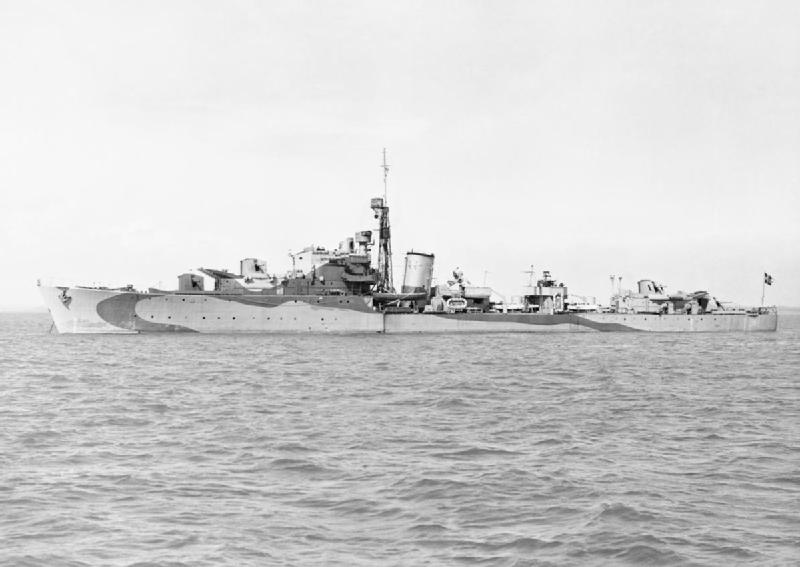
HNoMS Stord was a notable Royal Norwegian Navy destroyer with a distinguished service history during the Second World War. Originally laid down as HMS Success for the Royal Navy, she was transferred to Norway prior to completion in 1943 and commissioned under the name HNoMS Stord on August 26, 1943, under the command of Lt.-Cdr. Skule Storheill. Constructed with an overall length of 362 feet 9 inches (110.6 meters), she displaced 1,710 long tons (1,740 tonnes) at standard load and up to 2,530 long tons (2,570 tonnes) at deep load. Her beam measured approximately 35 feet 8 inches (10.9 meters), and she had a deep draught of 14 feet 6 inches (4.4 meters). Power was supplied by two Parsons geared steam turbines, each driving a propeller shaft, fueled by two Admiralty three-drum boilers, producing a total of 40,000 shaft horsepower (30,000 kW). This enabled her to reach a top speed of 36 knots (67 km/h; 41 mph). She carried a fuel oil capacity of 615 long tons (625 tonnes), providing a range of 4,675 nautical miles (8,658 km; 5,380 miles) at 20 knots (37 km/h; 23 mph). Her crew complement was approximately 170 officers and ratings. Her armament included four 4.7-inch (120 mm) Mark XII guns in dual-purpose mounts, designed for both surface and anti-aircraft combat. For anti-aircraft defense, she was equipped with one twin Bofors 40 mm gun mount and four twin 20 mm Oerlikon autocannons. She also carried two quadruple 21-inch (533 mm) torpedo tubes and was fitted with depth charge rails and throwers, with a total of 70 depth charges for anti-submarine warfare. Stord played a pivotal role in the Battle of the North Cape, notably participating in the sinking of the German battleship Scharnhorst. She approached within 400 yards of Scharnhorst to fire torpedoes, a daring action that drew commendation from Allied commanders; Admiral Fraser praised her bravery, and her commanding officer was noted for conducting the most daring attack in the engagement. Additionally, she took part in the Normandy landings in June 1944. After the war, she was officially purchased from the UK government in 1946 and remained in service until 1959, when she was scrapped in Belgium. A model of HNoMS Stord is displayed at the D-Day museum in Arromanches, Normandy, honoring her wartime service. Her crew members received posthumous recognition, including the Arctic Star, awarded to torpedo commander Håkon Nilsen and Chief Petty Officer Arne Olsen for their heroic actions during the war.
This description has been generated using GPT-4.1-NANO based on the Vessel's wikidata information and then modified by ShipIndex.org staff.