
HMS Champion
1915 C-class light cruiser
Vessel Wikidata
* This information from Wikidata is available under the Creative Commons Attribution-ShareAlike License
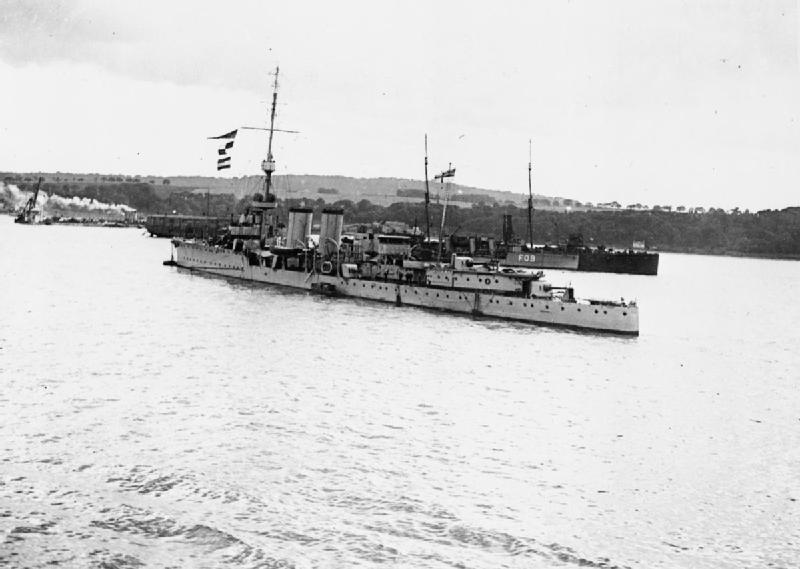
HMS Champion was a C-class light cruiser of the Royal Navy, part of the Calliope group, constructed during the early years of World War I. Built by Hawthorn Leslie and Company at Tyneside, England, she was laid down on March 9, 1914, launched on May 29, 1915, and completed by December of that year. Designed with experimental propulsion systems, Champion featured geared reduction gear in her engines, a deviation from the conventional direct-drive turbines used in her sister ships. This innovation aimed to optimize turbine and propeller efficiency, allowing for a more compact boiler room and reduced power output, initially designed at 37,500 shaft horsepower (shp). However, modifications during construction increased boiler capacity and added cruising turbines, ultimately restoring her power to approximately 41,000 shp, comparable to other ships in her class. Her propulsion system enabled her to reach a maximum speed of around 29.5 knots during trials, with fuel consumption of about 470 tons per day at that speed. The ship was armed and balanced for fleet operations, capable of sustained high-speed maneuvering. Commissioned into the Royal Navy on December 20, 1915, HMS Champion served primarily with the Grand Fleet, leading the 13th Destroyer Flotilla through the remainder of World War I. Notably, she participated in the Battle of Jutland (May 31 – June 1, 1916), where she acted as flagship for Commodore (D), the senior destroyer commander, playing a significant role in the fleet's destroyer actions. After the war, she briefly served with the 2nd Light Cruiser Squadron in 1919 and was subsequently assigned to the Royal Navy Torpedo School at HMS Vernon until 1924, undergoing a refit in 1923. Decommissioned in October 1924, she was later recommissioned in May 1925 as a Gunnery Firing Ship, and in 1928, she became part of the Signal School, serving as a testbed for the Royal Navy’s first remote-power-control gunnery systems. HMS Champion was finally decommissioned in December 1933 and sold for scrap in July 1934. Overall, HMS Champion's design and service record reflect her role as an experimental vessel and a key participant in wartime fleet actions, exemplifying early 20th-century naval innovation and the Royal Navy’s operational reach during World War I.
This description has been generated using GPT-4.1-NANO based on the Vessel's wikidata information and then modified by ShipIndex.org staff.