
Peruvian ironclad Independencia
Vessel Wikidata
* This information from Wikidata is available under the Creative Commons Attribution-ShareAlike License
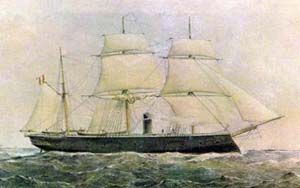
The BAP Independencia was a broadside ironclad constructed in England for the Peruvian Navy during the mid-1860s. She measured 215 feet (65.5 meters) in length between perpendiculars, with a beam of 44 feet 9 inches (13.6 meters) and a draft of 22 feet 6 inches (6.9 meters). Displacing approximately 3,500 long tons (3,600 metric tons), the vessel was powered by a trunk steam engine generating 2,200 indicated horsepower (1,600 kW), which propelled her at a top speed of around 12 knots (22 km/h). For extended voyages, Independencia was equipped with three masts rigged in a barque configuration, supporting her crew of 250 officers and sailors. Her armament comprised four Armstrong 7-inch (178 mm) guns mounted on pivot on the spar deck, twelve 6-inch (152 mm) guns, and four 30-pounder rifled muzzle-loading guns, all concentrated amidships as part of her central-battery design. The ship was also fitted with a bow ram and featured a hull divided into three watertight compartments, enhancing her survivability. Her armor protection included a 4.5-inch (110 mm) thick waterline armor belt and similarly armored battery plates, providing substantial defense against contemporary artillery. Independencia was built by Samuda Brothers at their shipyard in Poplar, London, laid down in 1864, launched on August 8, 1865, and completed by December 1866. She underwent boiler replacements in 1878, and in February 1879, her armament was upgraded with a 9-inch rifled, muzzle-loading pivot gun at the bow and a 150-pounder Parrott gun at the stern. During the War of the Pacific, on 21 May 1879, Independencia engaged in the Battle of Punta Gruesa. While pursuing the Chilean schooner Covadonga, she attempted to ram her but ran aground after her helmsman was shot. Covadonga turned to rake her, forcing her to surrender until the Chilean ironclad Huáscar intervened. The wreck was subsequently destroyed to prevent her capture, with only two 7-inch guns salvaged. Her loss marked a significant event in Peruvian naval history, illustrating the challenges faced by ironclad ships in wartime operations.
This description has been generated using GPT-4.1-NANO based on the Vessel's wikidata information and then modified by ShipIndex.org staff.