
SMS Elbing
1914 Pillau-class cruiser
Vessel Wikidata
* This information from Wikidata is available under the Creative Commons Attribution-ShareAlike License
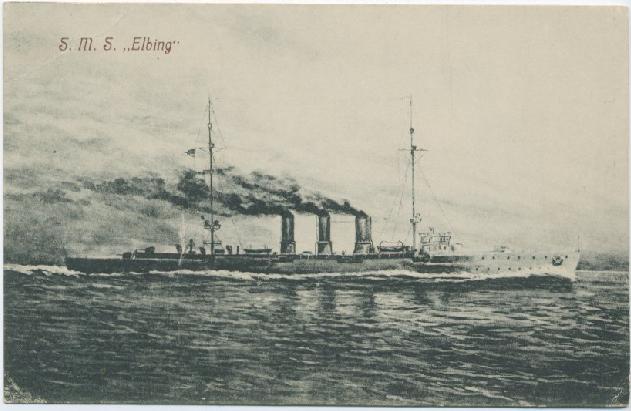
SMS Elbing was a German light cruiser constructed by the Schichau-Werke shipyard in Danzig, originally ordered by the Imperial Russian Navy under the name Admiral Nevelskoy. Laid down on 21 May 1913, she was requisitioned by Germany following the outbreak of World War I in August 1914 and launched on 21 November 1914. The vessel measured approximately 135.3 meters (444 feet) in length overall, with a beam of 13.6 meters (45 feet) and a draft of 5.98 meters (19.6 feet). She displaced around 4,390 tons normally and up to 5,252 tons at full load. Her superstructure included a raised forecastle, a conning tower aft of the forecastle, and deckhouses further aft, complemented by two pole masts with spotting platforms. Elbing was powered by two sets of Marine steam turbines driving twin 3.5-meter propellers, fed by six coal-fired and four oil-fired Yarrow water-tube boilers venting through three amidships funnels. Her propulsion system produced approximately 30,000 shaft horsepower, allowing her to reach a top speed of 27.5 knots. She carried a fuel load of 620 tons of coal and 580 tons of oil, granting her an operational range of about 4,300 nautical miles at 12 knots. Armament comprised eight 15 cm SK L/45 guns arranged in single pedestal mounts, with two forward, four amidships, and two aft. She was also equipped with four 5.2 cm SK L/55 anti-aircraft guns (later replaced with 8.8 cm guns), two 50 cm torpedo tubes, and could carry up to 120 mines. The ship's armor included up to 80 mm thick plates on the deck and 75 mm sides on the conning tower. Elbing's service history was marked by participation in key naval operations. She engaged in the bombardment of Yarmouth and Lowestoft in April 1916 and played a prominent role at the Battle of Jutland in May 1916, where she scored the first hit of the engagement. During the battle, she was heavily involved in night fighting but suffered critical damage after being accidentally rammed by the battleship Posen, which tore a hole in her hull. Flooding disabled her engines and electrical systems, leading to her immobilization. Her crew was evacuated by torpedo boat, and she was ultimately scuttled around 03:00 on 1 June 1916 to prevent her capture. Despite her limited operational lifespan, SMS Elbing remains notable for her participation in one of the largest naval battles of World War I and exemplifies the strategic importance of light cruisers in fleet scouting and coastal operations during the era.
This description has been generated using GPT-4.1-NANO based on the Vessel's wikidata information and then modified by ShipIndex.org staff.