
ARA Veinticinco de Mayo
1943 Colossus-class light aircraft carrier
Vessel Wikidata
* This information from Wikidata is available under the Creative Commons Attribution-ShareAlike License
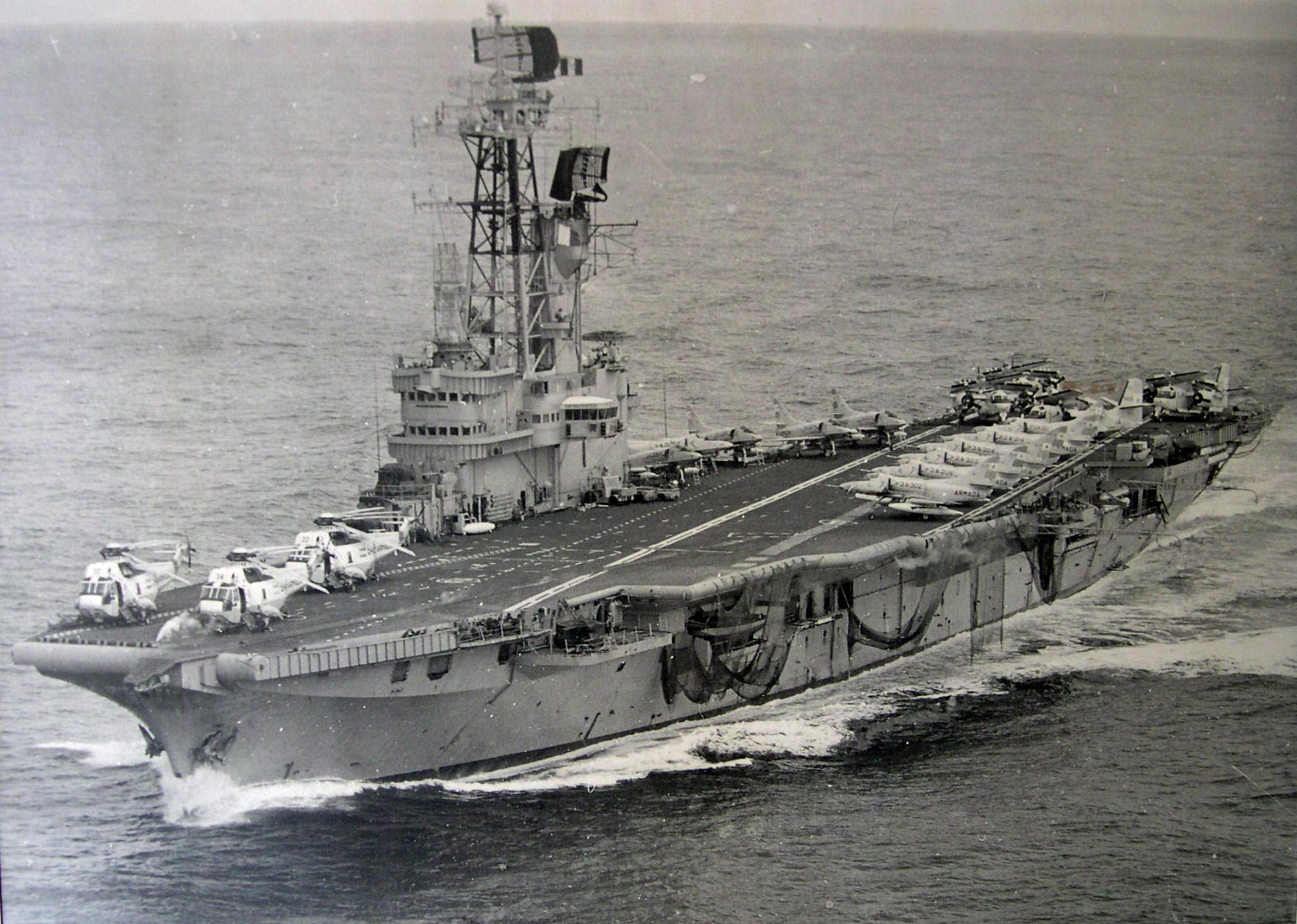
The ARA Veinticinco de Mayo (V-2) was a prominent light aircraft carrier serving in the Argentine Navy from 1969 until 1997. Originally built during World War II for the Royal Navy by Cammell Laird in Birkenhead, England, she was a Colossus-class carrier named HMS Venerable. She participated in the British Pacific Fleet before being sold to the Netherlands, where she was renamed HNLMS Karel Doorman. Following a boiler room fire and subsequent rebuild, she was sold to Argentina, becoming Veinticinco de Mayo. Measuring approximately 210 meters in length, the carrier was equipped with a steam catapult, arresting gear, and an angled flight deck, enabling her to operate a complement of up to 24 aircraft. Her initial air group comprised F9F Panthers and F9F Cougars, later replaced by A-4Q Skyhawks, supported by S-2 Tracker anti-submarine aircraft and Sikorsky Sea King helicopters. During her service, she underwent several refits; notably, in 1981, she received updates to her radar, catapult, and arresting gear, and her forward port side deck was enlarged to facilitate the operation of more advanced aircraft, although attempts to operate the French Super Étendard strike aircraft faced technical challenges. Veinticinco de Mayo played a strategic role during regional crises, including the Beagle Crisis of 1978 and the Falklands War in 1982. She supported Argentine landings and was positioned defensively near the Falklands, where British submarine HMS Splendid tracked her. Although she prepared to launch an attack on the British fleet, the strike was ultimately not executed. Her aircraft were also flown from Tierra del Fuego after the sinking of the aircraft carrier ARA Independencia and the general retreat from active combat. Throughout her operational life, she was modernized but suffered from engine problems from 1986 onward, limiting her to port duties. Plans for a comprehensive refit with gas turbines were halted by financial constraints, leading to her decommissioning and eventual scrapping in India in 2000. Her legacy remains as Argentina's most significant carrier, representing a key element of its naval aviation history.
This description has been generated using GPT-4.1-NANO based on the Vessel's wikidata information and then modified by ShipIndex.org staff.