
USS Essex
1799 fifth-rate frigate
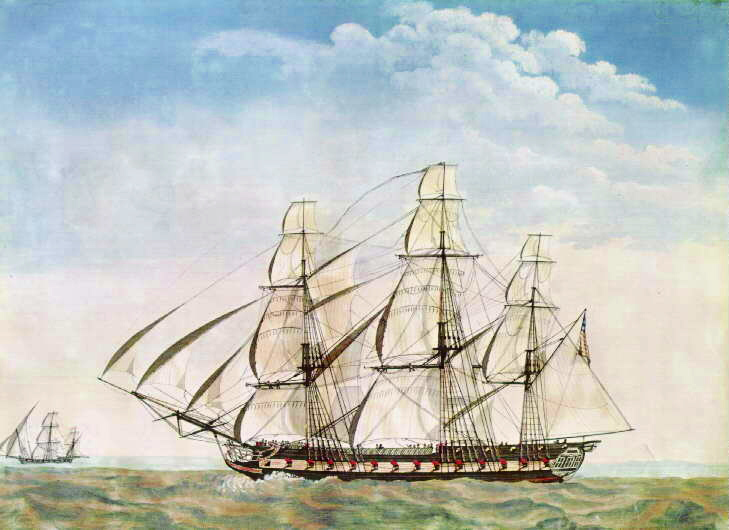
Vessel Wikidata
* This information from Wikidata is available under the Creative Commons Attribution-ShareAlike License
The USS Essex (1799) was a notable United States Navy sailing frigate, initially classified as either a 36-gun or 32-gun vessel. Built in Salem, Massachusetts by Enos Briggs at a cost of $139,362, she was launched on September 30, 1799, based on a design by James Hackett. Her armament consisted mainly of short-range carronades, which limited her at longer distances compared to the more traditional long-range naval guns. The Essex was accepted into the Navy on December 17, 1799, under Captain Edward Preble. Constructed with an overall length suited for a frigate of her era, she participated actively in several significant conflicts, including the Quasi-War with France, the First Barbary War, and the War of 1812. Her service record includes escorting merchant convoys, engaging in blockade operations, and capturing enemy vessels. Notably, during the Quasi-War, she became the first U.S. naval ship to cross the Equator and double the Cape of Good Hope, demonstrating her long-range operational capabilities. During the War of 1812, under Captain David Porter, Essex achieved considerable success in the South Atlantic, capturing multiple British prizes, including a sloop and ten ships in total, and disrupting British whaling operations in the Pacific. Her crew included a young Midshipman David Glasgow Farragut, who would later become the first American admiral. However, her career ended in 1814 when she was captured by the British frigate HMS Phoebe off Valparaíso after a fierce battle. Armed primarily with short-range carronades, Essex was at a disadvantage against the British long-range guns, leading to her surrender after suffering significant casualties—58 dead and 31 missing out of 214 crew. The British took her into service as HMS Essex, though she was never fitted for active sea duty and was later used as a troopship and prison hulk before being sold in 1837. The USS Essex’s historical significance lies in her extensive service during early American naval conflicts and her role in pioneering naval operations across the Atlantic and Pacific theaters. Her story has been memorialized in literature and film, notably in Herman Melville’s writings and Patrick O’Brian’s novels.
This description has been generated using GPT-4.1-NANO based on the Vessel's wikidata information and then modified by ShipIndex.org staff.