
SS Leviathan
1913 Imperator-class ocean liner
Vessel Wikidata
* This information from Wikidata is available under the Creative Commons Attribution-ShareAlike License
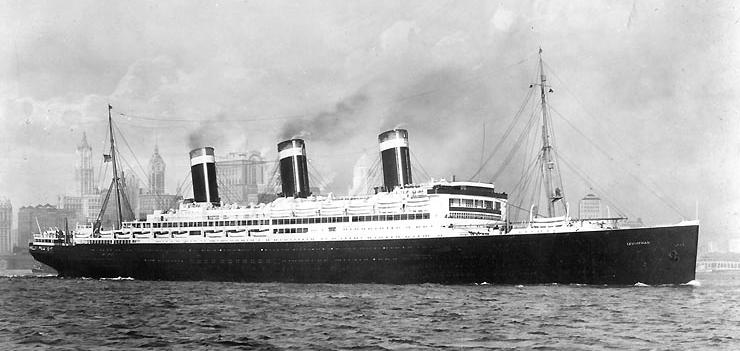
The SS Leviathan was a monumental ocean liner originally launched as the SS Vaterland on April 3, 1913, by Blohm & Voss in Hamburg, Germany. As the second of three sister ships of the Imperator class for Hamburg America Line, Vaterland was designed to be among the largest passenger vessels in the world, with a gross tonnage of approximately 53,500 GRT. She measured about 1,025 feet in length, with a beam of 87.8 meters, and was powered by four steam turbines connected to four propellers, enabling her to reach speeds averaging around 27.5 knots. Her construction featured advanced German shipbuilding standards, including a double bottom, double skin above the waterline, and steel bulkheads, with five decks and four superimposed decks for a total of nine decks above water. Vaterland's interior was notable for its elegant arrangements, including a main dining room modeled after the New York Ritz-Carlton, public rooms arranged along a side routing for unbroken vistas, and luxurious public spaces. Her passenger capacity was set at approximately 4,050, with accommodations divided among first, second, third, and fourth classes, the latter accommodating the majority of passengers in less luxurious conditions. Her maiden voyage to New York took place in May 1914, amid celebrations, but her commercial service was short-lived due to the outbreak of World War I. She was laid up in the United States after the war's start and seized by the U.S. government in 1917 upon U.S. entry into the war. Converted into a troopship, she was renamed USS Leviathan and commissioned in September 1917. During WWI, she transported over 119,000 troops across the Atlantic, often in overcrowded conditions, and participated in ten round-trip voyages. She was heavily utilized during the war, with her impressive speed allowing transits without escort. Post-war, Leviathan underwent extensive refitting, including a complete overhaul at Newport News, where her tonnage increased to nearly 60,000 GRT and her interior was modernized in art deco style. She resumed transatlantic service in 1923 under United States Lines, quickly becoming popular but never profitable due to high operational costs, Prohibition restrictions, and economic downturns. Throughout the 1920s and early 1930s, Leviathan set passenger records and was advertised as the largest and fastest liner, though her claims were challenged by British rivals. By the late 1930s, her economic viability declined, and she was sold for scrapping, arriving at Rosyth, Scotland, in February 1938. Her demolition was completed in 1940. Throughout her nearly 25-year career, Leviathan was a symbol of American maritime power, widely recognized for her size, speed, and luxury, despite never turning a profit during her operational lifetime.
This description has been generated using GPT-4.1-NANO based on the Vessel's wikidata information and then modified by ShipIndex.org staff.