
USS Haraden
1918 Town-class destroyer
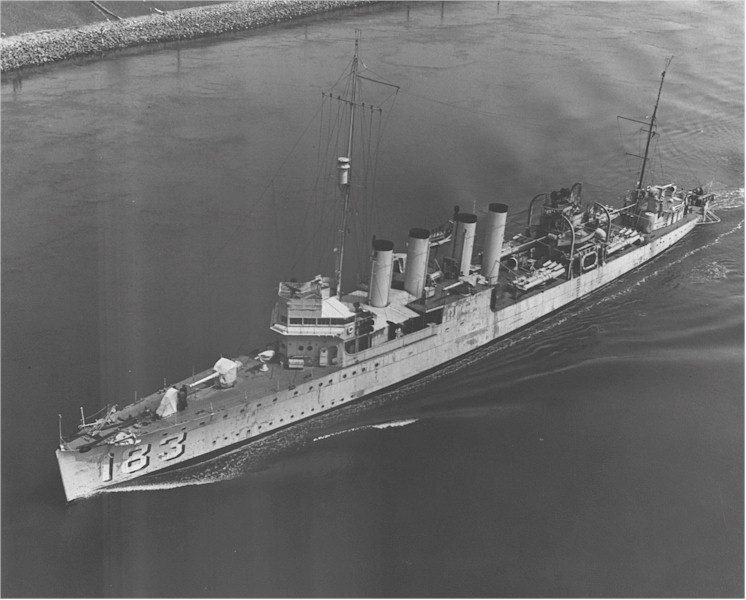
Vessel Wikidata
* This information from Wikidata is available under the Creative Commons Attribution-ShareAlike License
The USS Haraden (DD–183) was a Wickes-class destroyer built for the United States Navy, launched on July 4, 1918, by Newport News Shipbuilding and Dry Dock Company in Virginia. She was commissioned on June 7, 1919, at Norfolk Navy Yard. The vessel measured approximately 314 feet in length, with a beam of about 30 feet, and was armed with torpedoes, guns, and other armaments typical of the Wickes-class, designed for fast, versatile naval operations. Initially assigned to U.S. Naval Forces in European waters, Haraden departed New York on June 30, 1919, for the Adriatic Sea, arriving at Split on July 28, 1919. She played a role in post-World War I operations, serving as a station ship at Trieste and Rijeka, assisting in the enforcement of Austrian armistice terms, and participating in naval maneuvers. After her European duty, she returned to Norfolk in November 1919, and subsequently operated along the U.S. East Coast, including Charleston and Newport, until she was decommissioned on July 17, 1922. Reactivated in December 1939 amid rising tensions, Haraden was recommissioned at Philadelphia and conducted neutrality patrols in the Caribbean and off the U.S. East Coast, including Chesapeake Bay. In September 1940, she was transferred to the United Kingdom as part of the destroyers-for-bases agreement, decommissioned from the U.S. Navy, and renamed HMCS Columbia under the Royal Canadian Navy, following Canadian naming conventions. As HMCS Columbia, the vessel was refitted for convoy escort duties across the Atlantic. Her earliest notable engagement occurred on October 15, 1941, when she joined convoy SC 48, which was under submarine attack, resulting in the loss of nine merchant ships. She continued convoy and anti-submarine operations until February 25, 1944. That year, she struck a cliff in severe weather off Newfoundland but was not fully repaired afterward. Instead, she was repurposed as a fuel and ammunition hulk in Nova Scotia until she was sold for scrapping in August 1945. Her service highlights her transition from a World War I-era destroyer to a vital component of Atlantic convoy defenses during World War II.
This description has been generated using GPT-4.1-NANO based on the Vessel's wikidata information and then modified by ShipIndex.org staff.