
HMS Hercules
1868 ironclad of the Royal Navy
Vessel Wikidata
* This information from Wikidata is available under the Creative Commons Attribution-ShareAlike License
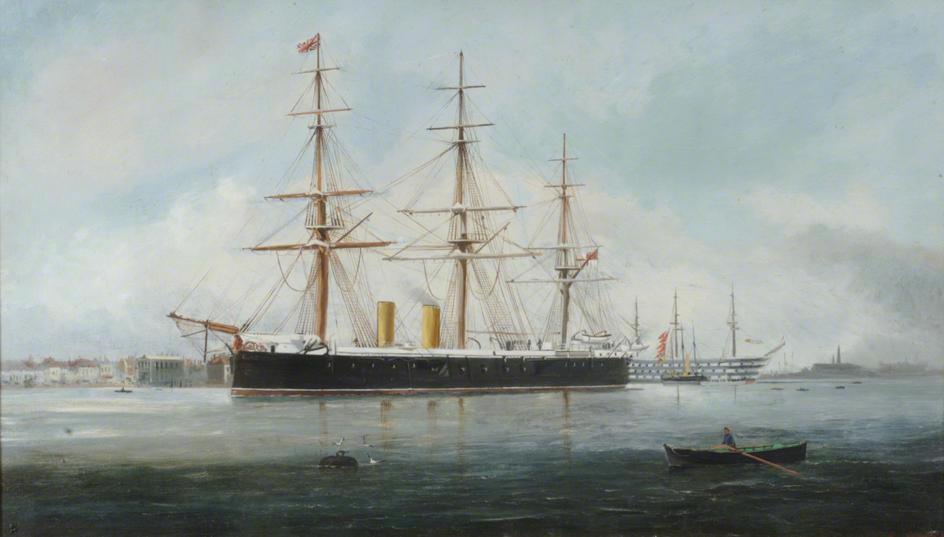
HMS Hercules was a Victorian-era central-battery ironclad of the Royal Navy, notable for being the first warship to mount a main armament of 10-inch (250 mm) muzzle-loading rifles. Designed by Sir Edward Reed, she was an enlarged, more heavily armed version of the earlier HMS Bellerophon, featuring thicker armor and heavier guns. Her construction included a pointed ram, replacing the previous rounded design, and she was initially built with a forecastle, later fitted with a poop deck in preparation for her role as flagship of the Mediterranean Fleet. Her hull was fitted with a balanced rudder, which reduced the effort needed for turning, and steam-powered steering was added in 1874. Hercules's armament was revolutionary for her time, with four 10-inch (250 mm) guns arranged in a box battery on either side. These guns, each weighing 18 tons, fired 400-pound shells at a muzzle velocity of 1,380 ft/s. The arrangement allowed the foremost and aftermost guns to traverse to fire close to the ship's line of keel, through recessed embrasures, enhancing her broadside and end-on fire capabilities. Additional armament included a 9-inch (230 mm) gun at the stem and stern for end-on fire, and 7-inch (180 mm) guns mounted on the upper deck for broadside and end-on firing. From 1878, she was also equipped with two 14-inch Whitehead torpedo carriages. Her service record began with commissioning at Chatham, serving in the Channel Fleet until 1874. She experienced some damage to her guns in 1870 and 1872, with shells bursting prematurely. Notably, she towed HMS Agincourt off Gibraltar in 1871, and in 1872, she was involved in a storm incident at Madeira, where she sustained damage after a collision with HMS Northumberland. After a refit from 1874 to 1875, she served as flagship of the Mediterranean Fleet until 1877, then as a guardship and reserve fleet flagship. Modernized in 1892–1893, she remained in reserve until 1904, serving briefly as a port guard ship at Portland and Portsmouth. Her later years saw her renamed Calcutta in 1909, serving as a depot ship at Gibraltar, and eventually as an artificers' training establishment at Portsmouth under the name Fisgard II. By this time, her appearance had been heavily modified, lacking masts and armament. She was sold for scrap in 1922, marking the end of her maritime career. Her design and service exemplify the transitional period of naval technology during the late 19th century, reflecting significant advancements in armor and artillery.
This description has been generated using GPT-4.1-NANO based on the Vessel's wikidata information and then modified by ShipIndex.org staff.