
HMS Alnwick Castle
1944 Castle-class corvette
Vessel Wikidata
* This information from Wikidata is available under the Creative Commons Attribution-ShareAlike License
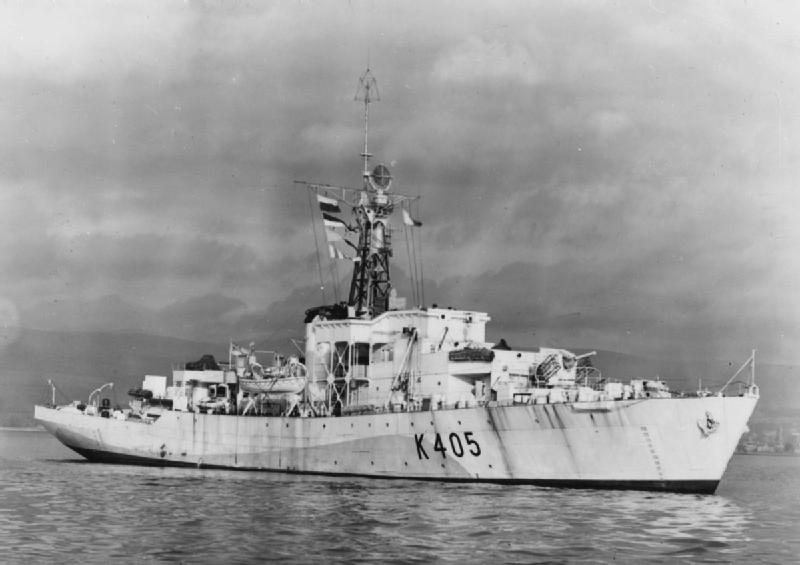
HMS Alnwick Castle (K405) was a Castle-class corvette built for the Royal Navy during World War II. Constructed by George Brown & Co. at Greenock, she was laid down on 12 June 1943, launched on 23 May 1944, and completed by 11 November 1944. As a member of the Castle class, she represented an enlarged, more seakeeping version of the earlier Flower class, designed to enhance operational capabilities and modernize armament. The vessel measured 252 feet (76.8 meters) in length, with a beam of 36 feet 9 inches (11.2 meters) and a deep draught of 14 feet (4.3 meters). Displacing approximately 1,010 long tons (1,030 metric tons) at standard load and 1,510 long tons (1,530 metric tons) at deep load, HMS Alnwick Castle was powered by two triple-expansion steam engines producing a total of 2,880 indicated horsepower, driving twin propellers. This propulsion enabled a maximum speed of 16.5 knots (about 30.6 km/h). She had a range of 6,500 nautical miles (12,000 km) at 15 knots, suitable for extended convoy escort missions. The crew complement consisted of around 99 officers and ratings. Her armament included a single QF 4-inch (102 mm) Mk XVI gun at the bow and a primary anti-submarine weapon, the three-barrel Squid mortar. Defensive armament comprised one depth charge rail and two throwers for deploying 15 depth charges, along with several Oerlikon 20 mm AA guns—initially two twin mounts and two singles, with provisions for additional mounts. The ship was equipped with ASDIC sonar systems (Type 145Q and Type 147B), a Type 277 search radar, and a HF/DF radio direction finder, making her well-suited for anti-submarine warfare. HMS Alnwick Castle served primarily as a convoy escort during the final year of WWII, notably participating in the sinking of the German U-boat U-425 on 17 February 1945 near Murmansk. After hostilities ended, she was placed in reserve on 25 May 1945 and remained inactive until she was sold for scrap in 1958, arriving at Gateshead for dismantling in December of that year. Her service exemplifies the crucial role of Castle-class corvettes in maintaining Allied maritime security during WWII.
This description has been generated using GPT-4.1-NANO based on the Vessel's wikidata information and then modified by ShipIndex.org staff.