
French ironclad Colbert
1875 Colbert-class ironclad
Vessel Wikidata
* This information from Wikidata is available under the Creative Commons Attribution-ShareAlike License
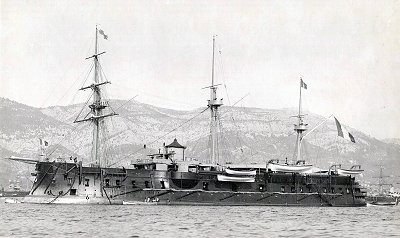
The French ironclad Colbert was the leading vessel of the Colbert-class, constructed for the French Navy in the 1870s. She was a central battery ironclad with a length of 101.1 meters (331 ft 8 in), a beam of 17.4 meters (57 ft 1 in), and a maximum draft of 8.5 meters (27 ft 11 in). Displacing 8,617 metric tons, her armor included a wrought iron waterline belt 220 mm thick amidships, tapering to 180 mm at the stern, supported by wood backing. The battery casemate was armored with 160 mm wrought iron, backed by 62 mm of wood, and her ends with 120 mm transverse bulkheads backed by 480 mm of wood. Her deck had an armor thickness of 15 mm. The ship was powered by a single Wolf 3-cylinder horizontal return connecting rod compound steam engine, driving one propeller, with eight oval boilers providing 4,600 indicated horsepower. During sea trials, she achieved a speed of 14.75 knots and had a cruising range of approximately 3,300 nautical miles at 10 knots. She was rigged with three masts and carried around 620 tons of coal, complemented by a sail area of about 2,100 square meters. Armament included two 274 mm (10.8 in) guns in barbettes amidships, with additional guns on the battery deck, and a 240 mm (9.4 in) chase gun mounted in the forecastle. She also carried six 138 mm guns, later augmented with an additional 240 mm gun, and four above-water 356 mm torpedo tubes. Her guns could fire both solid shot and explosive shells, with the 274 mm gun capable of penetrating 14.3 inches of wrought iron armor. Laid down at Brest on July 4, 1870, and launched on September 16, 1875, her construction faced delays likely due to budget reductions and outdated practices. She began sea trials in May 1877, became flagship of the Reserve Squadron in August 1878, and served as the flagship of the Mediterranean Squadron from 1879 to 1890. Notably, Colbert participated in shelling and landing troops at Sfax during the French conquest of Tunisia in July 1881. She later took part in convoy escort exercises in 1887, demonstrating her strategic role in France's naval operations. Decommissioned and disarmed in 1895, she was condemned in 1900 and sold for scrap in 1909, marking her as an important example of late 19th-century French ironclad design and naval strategy.
This description has been generated using GPT-4.1-NANO based on the Vessel's wikidata information and then modified by ShipIndex.org staff.