
SMS Nürnberg
1906 Königsberg-class cruiser
Vessel Wikidata
* This information from Wikidata is available under the Creative Commons Attribution-ShareAlike License
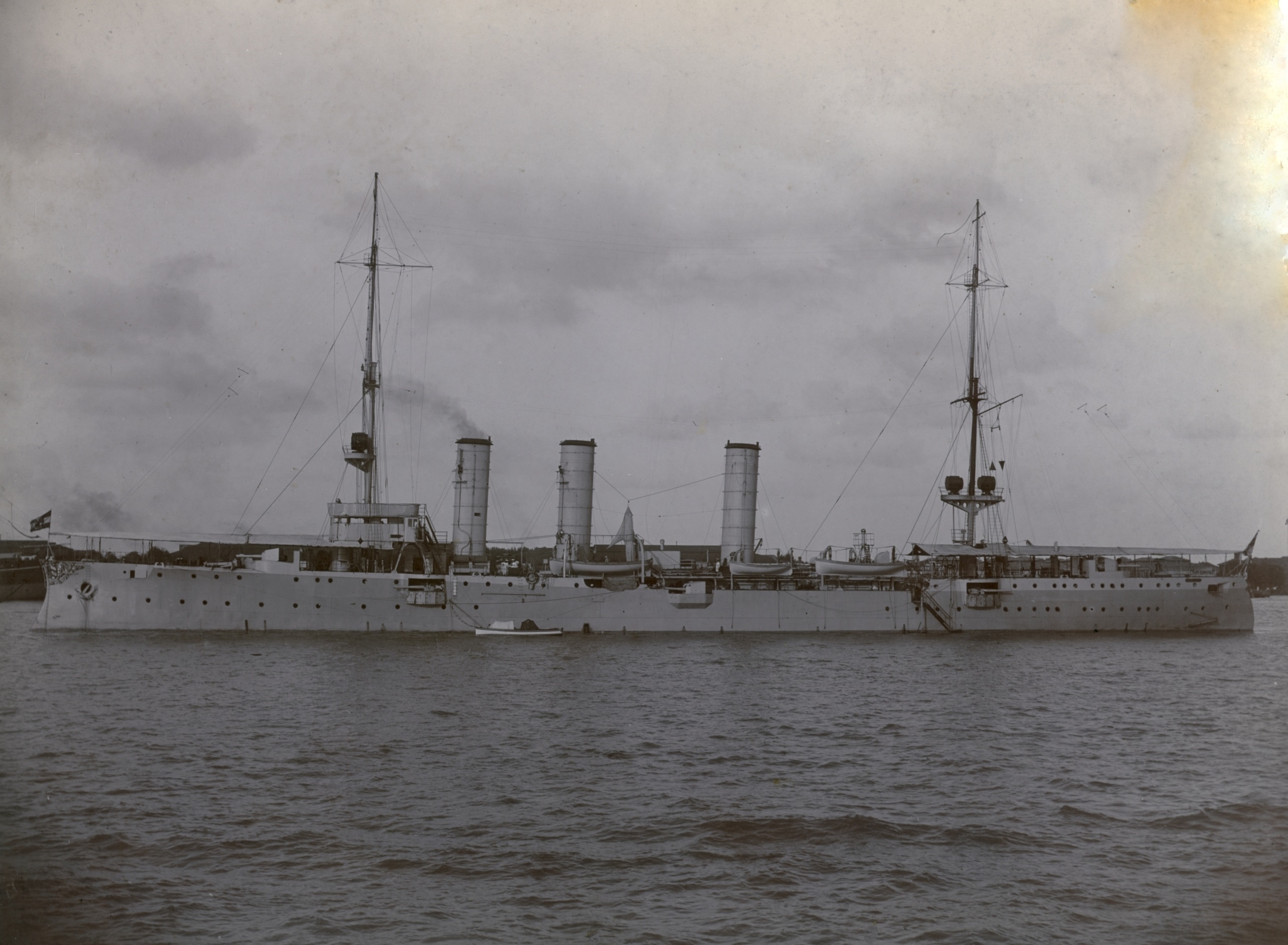
SMS Nürnberg was a Königsberg-class light cruiser constructed for the German Imperial Navy, built by the Imperial Dockyard in Kiel. Laid down in early 1906 and launched in August of the same year, she was commissioned in April 1908. The vessel measured approximately 116.8 meters (383 feet) in length overall, with a beam of 13.3 meters (44 feet) and a draft of 5.24 meters (17.2 feet). Displacing about 3,469 tons normally and up to 3,902 tons at full load, Nürnberg featured a minimal superstructure, including a small conning tower and two pole masts, with a hull that had a raised forecastle and a pronounced ram bow. Powered by two triple-expansion steam engines driving two screw propellers, Nürnberg was fueled by eleven coal-fired water-tube boilers venting through three funnels. Her engines produced around 13,200 metric horsepower, enabling her to reach a top speed of 23.4 knots, with an operational range of roughly 4,120 nautical miles at 12 knots, thanks to a coal capacity of 400 tons. Armament comprised ten 10.5 cm SK L/40 guns arranged with two forward, six on broadside, and two aft, supplemented by eight 5.2 cm SK guns for close defense, and two submerged 45 cm torpedo tubes. Her armor protection included an 80 mm curved deck with sloped sides, and a conning tower with 100 mm thick sides. Nürnberg’s service history was marked by deployment to the East Asia Squadron starting in 1910, where she participated in regional patrols, port visits, and colonial operations, including involvement in suppressing the Sokehs Rebellion in German Samoa in early 1911. She also protected German nationals during regional unrest and conducted reconnaissance and patrol missions along the Chinese coast during the early years of the Chinese Revolution. During World War I, Nürnberg was part of Vice Admiral Maximilian von Spee’s squadron, engaging in various operations across the Pacific. Her most notable combat occurred during the Battle of Coronel in November 1914, where she helped finish off the British cruiser HMS Monmouth. Later, she participated in the attempted raid on the Falkland Islands but was sunk by the British cruiser HMS Kent on 1 November 1914. Her sinking resulted in the loss of 327 crew members, including Otto von Spee, with her remains resting off the coast of the Falkland Islands. Nürnberg’s operational history underscores her role as a versatile cruiser intended for fleet scouting and colonial duties, her engagement and eventual sinking exemplifying the naval conflicts of early World War I.
This description has been generated using GPT-4.1-NANO based on the Vessel's wikidata information and then modified by ShipIndex.org staff.