
HMAS Burra Bra
Many ferry requisitioned by Royal Australian Navy
Vessel Wikidata
* This information from Wikidata is available under the Creative Commons Attribution-ShareAlike License
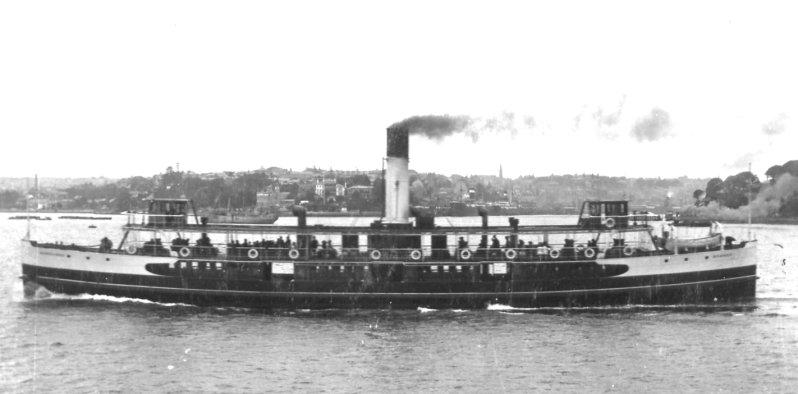
HMAS Burra Bra was originally a Manly ferry constructed for the Sydney Harbour service by Mort Docks and Engineering Co, Woolwich. Launched on 17 June 1908, she was the second of six vessels in the Binngarra class, designed for passenger transport across Sydney Harbour. Measuring approximately 59 meters in length and with a gross tonnage of 458 tons, she could carry up to 1,448 passengers, though her capacity was reduced to 916 during winter due to her open upper deck configuration. Her triple-expansion steam engines produced 100 horsepower, allowing her to reach a maximum speed of 13 knots. As a double-ended screw ferry, Burra Bra was part of a fleet that transitioned from paddle steamers to screw propulsion, addressing the challenges of maneuvering in narrow and busy Sydney Harbour. She was almost identical to her sister ships, including the Binngarra, Bellubera, Balgowlah, Barrenjoey, and Baragoola, with her open upper deck remaining a distinctive feature, unlike some of her sister vessels which later had enclosed decks. Burra Bra's service included notable events such as ferrying delegates during the 1928 Roman Catholic Congress, during which she was decorated in white with large crosses on her funnel, and serving as the flagship for the Pittwater Regatta in 1929. She was known for her role in Sydney Harbour's transportation network until her withdrawal from service in 1940. During World War II, she was requisitioned by the Royal Australian Navy on 13 November 1942, stripped of her superstructure, and fitted with armaments including a 12-pounder gun, Vickers machine guns, and depth charge chutes. Commissioned as HMAS Burra Bra (Pennant Number 69) on 1 February 1943, she served at Jervis Bay as an anti-submarine training vessel and target tow. After her military service, she was laid up in 1944, used to supply steam to vessels under refit, and eventually sold in 1947 for scrapping before being scuttled at sea. Her maritime significance lies in her role as a representative example of early 20th-century Sydney Harbour ferries and her adaptation for wartime service.
This description has been generated using GPT-4.1-NANO based on the Vessel's wikidata information and then modified by ShipIndex.org staff.