
HMCS Sioux
1943 U and V-class destroyer
Vessel Wikidata
* This information from Wikidata is available under the Creative Commons Attribution-ShareAlike License
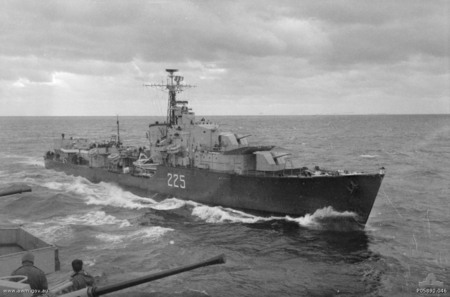
HMCS Sioux was a V-class destroyer of the Royal Canadian Navy, notable for its service during World War II and the Korean War. Originally ordered on 1 September 1941 as HMS Vixen for the British Royal Navy, her keel was laid on 31 October 1942 by J. Samuel White at Cowes. She was launched on 14 September 1943 and was adopted by the town of Kirkcaldy, Fife, during Warship Week in January 1942. The vessel was transferred to the Royal Canadian Navy, commissioned and renamed HMCS Sioux on 21 February 1944, and completed on 5 March 1944. Constructed as a V-class destroyer, Sioux joined the British Home Fleet's 26th Destroyer Flotilla at Scapa Flow. Her wartime activities included escorting convoy JW 58 to Russia, participating in Operation Tungsten against the German battleship Tirpitz, and providing naval gunfire support during the Normandy invasion, notably bombarding shore batteries at Juno Beach. Sioux also engaged in screening operations off Norway, attacking German shipping, and supporting operations aimed at disabling the Tirpitz. She escorted multiple convoys to the Soviet Union, notably JW and RA series, and participated in air-mining and attack missions along Norway's coast. In 1945, Sioux was transferred to the Pacific theater, undergoing a major refit at Halifax before transferring to the west coast. Postwar, she was modernized in 1950, losing her 'X' and 'Y' gun turrets for Squid anti-submarine mortars and becoming the first Canadian warship fitted with bunks instead of hammocks. She participated in a training cruise to Mexico in 1950. During the Korean War, Sioux was deployed to the Far East, arriving in July 1950. She supported the Inchon landings, enforced blockades, bombarded shore targets, and provided blockade and evacuation support along the Korean coast. Sioux was involved in multiple tours, including blockade duties, screening American aircraft carriers, and providing general naval support until she was the last Canadian vessel to depart Korean waters. She returned to Canada in 1951 and continued service until her decommissioning on 30 October 1963. Converted to a frigate in 1959, she was broken up in La Spezia, Italy, in 1965. Her ship's bell, inscribed with the names of 48 children baptized aboard her, remains a commemorative artifact.
This description has been generated using GPT-4.1-NANO based on the Vessel's wikidata information and then modified by ShipIndex.org staff.