
HMCS Summerside
1941 Flower-class corvette
Vessel Wikidata
* This information from Wikidata is available under the Creative Commons Attribution-ShareAlike License
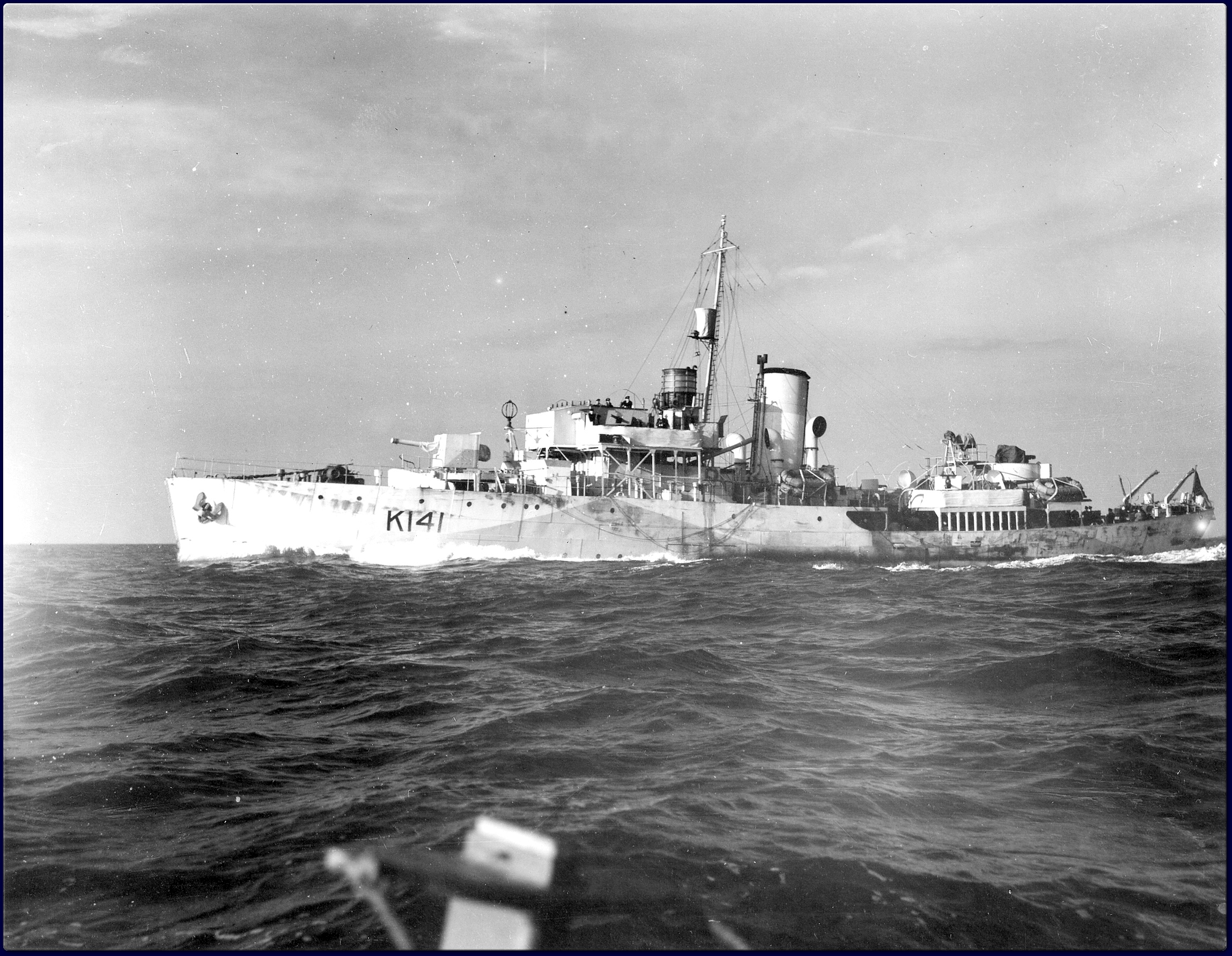
HMCS Summerside was a Flower-class corvette that served with the Royal Canadian Navy during the Second World War. Constructed as part of the 1939-1940 building program, she was ordered on 23 January 1940, laid down by Morton Engineering & Dry Dock Co. in Quebec on 4 October 1940, and launched on 7 May 1941. She was commissioned on 11 September 1941 at Quebec City. Design-wise, Summerside was typical of Flower-class corvettes, small warships originally based on a whaling ship design, adapted for escort duties. Canadian corvettes like Summerside primarily served in coastal auxiliary roles, including minesweeping, but were later modified for better performance on the open sea. She underwent three significant refits: the first in the UK, where additional anti-aircraft armament (two 20-mm Oerlikon guns) was added in preparation for Operation Torch; the second at Saint John from April to September 1943, which included extending her forecastle; and a final refit at Liverpool, Nova Scotia, starting in October 1944 and completed at Halifax in January 1945. Throughout her service, Summerside operated in multiple theaters. Initially assigned to Halifax Force, she was soon transferred to Sydney Force as a local escort. In December 1941, she joined Newfoundland Command, escorting convoys between St. John’s and Iceland, and was part of escort groups N14 and N16. From March 1942, she served with the Western Local Escort Force (WLEF), and briefly with the Gulf Escort Force in July. Notably, in October 1942, she participated in Operation Torch, the North African invasion, operating out of the UK with escort groups 26L, 26W, 26G, and 62G. During this campaign, she and Rosthern rescued survivors from the torpedoed American tanker Pan New York and subsequently sank the damaged vessel. In 1943, after a major refit, Summerside joined the Mid-Ocean Escort Force (MOEF) for Atlantic convoy duty, remaining until April 1944. She then returned to the UK, joining Western Approaches Command for invasion duties, including participation in Operation Neptune, the Normandy landings (D-Day). After further refits and workups in Bermuda, she served out the remainder of the war based out of Plymouth with escort group 41. Decommissioned on 6 July 1945 at Sorel, Quebec, Summerside was sold for scrap and broken up in June 1946 in Hamilton, Ontario. Her service record highlights her versatility and critical role in convoy escort and amphibious operations during WWII, marking her as a significant element of Canadian naval wartime efforts.
This description has been generated using GPT-4.1-NANO based on the Vessel's wikidata information and then modified by ShipIndex.org staff.