
HMS Agincourt
1865 Minotaur-class ironclad
Vessel Wikidata
* This information from Wikidata is available under the Creative Commons Attribution-ShareAlike License
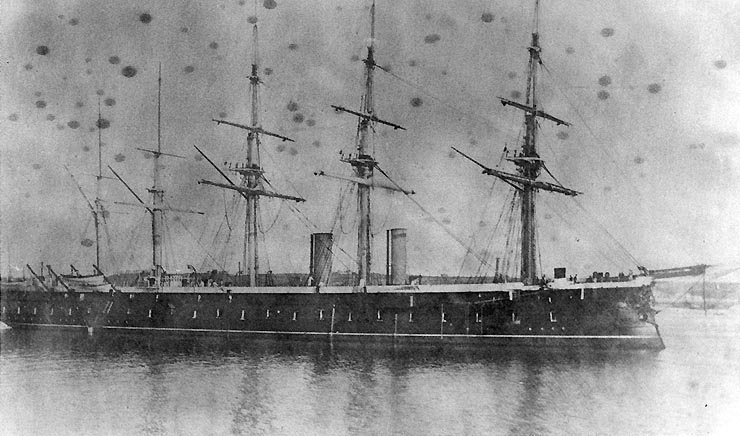
HMS Agincourt was a Minotaur-class armoured frigate constructed for the Royal Navy in the 1860s. She measured approximately 400 feet (121.9 meters) in length between perpendiculars and 407 feet (124.1 meters) overall, with a beam of 58 feet 6 inches (17.8 meters) and a draft of 26 feet 10 inches (8.2 meters). Displacing about 10,627 long tons (10,798 tons), her hull was subdivided by 15 watertight transverse bulkheads and featured a double bottom beneath the engine and boiler rooms. The ship's construction involved a fully armoured side protection tapering from 4.5 to 5.5 inches (114–140 mm), extending 5 feet 9 inches (1.8 meters) below the waterline, with additional teak backing for the armor. Powered by a single 2-cylinder horizontal return connecting rod-steam engine made by Maudslay, Agincourt produced 4,426 indicated horsepower during trials, reaching speeds of 13.55 knots (25.09 km/h). She carried 750 long tons (760 tons) of coal, enabling a steaming range of 1,500 nautical miles at 7.5 knots. Her propulsion system was supplemented by five masts and a sail area of 32,377 square feet (3,008 m²). However, her sailing performance was limited, with a maximum under sail of only 9.5 knots, partly due to her propeller not being hoistable and the semi-retractable funnels designed to reduce wind resistance. Originally intended to be heavily armed with rifled 110-pounder breech-loading guns, these were replaced by a mix of nine-inch and seven-inch rifled muzzle-loading guns after the initial design proved problematic. Her armament was later updated to include 17 nine-inch guns, quick-firing guns, machine guns, and torpedo tubes, reflecting evolving naval tactics. The ship's armour was backed by 10 inches of teak, with protection extending below the waterline. HMS Agincourt’s service history included serving as the flagship of the Channel Squadron’s second-in-command and participating in notable events such as the deployment to Constantinople during the Russo-Turkish War of 1877–78. She was involved in a near-disaster when she ran aground on Pearl Rock in 1871 but was refloated after repairs. Throughout her career, she served in various roles, including as a depot and training ship, before being converted into a coal hulk in 1909 under the name C.109. Her long service ended with her scrapping beginning in 1960, marking her as a significant vessel of the Victorian naval fleet.
This description has been generated using GPT-4.1-NANO based on the Vessel's wikidata information and then modified by ShipIndex.org staff.