
HMS Algerine
1895 Phoenix-class screw sloop
Vessel Wikidata
* This information from Wikidata is available under the Creative Commons Attribution-ShareAlike License
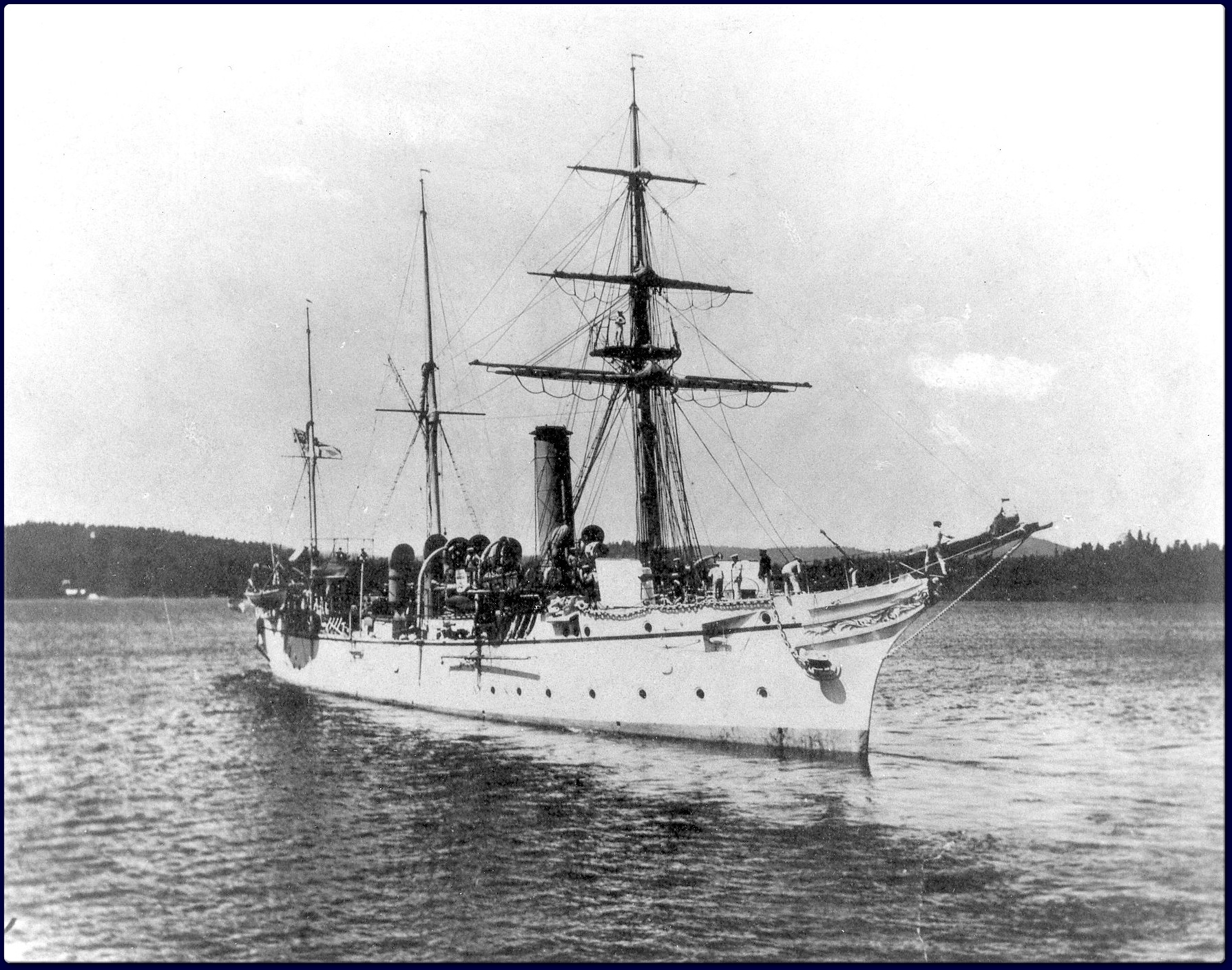
HMS Algerine was a Phoenix-class steel screw sloop of the Royal Navy, launched at Devonport in 1895. She measured 210 feet 6 inches overall, with a length between perpendiculars of 185 feet, a beam of 32 feet 6 inches, and a draught of 13 feet 1 inch. Constructed from steel, the vessel featured a protective steel deck ranging from 1 to 1.5 inches over her machinery and boilers. Her design was a twin-screw version of the Alert-class, created by Sir William White, with her machinery built at Devonport Dockyard. She was powered by a three-cylinder vertical triple-expansion steam engine producing 1,400 indicated horsepower, driving twin screws, which allowed her to reach a maximum speed of 13 knots. Initially rigged with a barquentine sail plan—square-rigged on the foremast and fore-and-aft rigged on the main and mizzen masts—her sails were later removed, although the masts remained. Her armament comprised six 4-inch quick-firing guns, four 3-pounder guns, and three .45 caliber Maxim machine guns, making her a versatile combat vessel in her era. HMS Algerine's service history includes deployment to the China Station, where she saw action during the Boxer Rebellion. She participated in the attack on the Taku Forts in June 1900 and contributed to the capture of Tientsin, landing a 4-inch gun used in combat. She was recommissioned at Hong Kong in 1900 under Commander Robert Hathorn Johnston Stewart. Later, she served on the Pacific Station at Esquimalt, along the Canadian West Coast. At the outbreak of World War I, Algerine was part of an international squadron off Mexico’s coast, protecting foreign interests during the Mexican civil war. She briefly engaged German cruisers in 1914 but soon was laid up at Esquimalt, with her crew transferred to other vessels. In 1917, she was lent to the Royal Canadian Navy as a depot ship. Sold in 1919 for salvage work, she was wrecked in 1923 after running aground on Brodie Rock in British Columbia, and subsequently sold for scrap in 1924. Her maritime significance lies in her active service during key historical events, including the Boxer Rebellion and early World War I operations.
This description has been generated using GPT-4.1-NANO based on the Vessel's wikidata information and then modified by ShipIndex.org staff.