
HMS Campania
1943 Nairana-class escort carrier
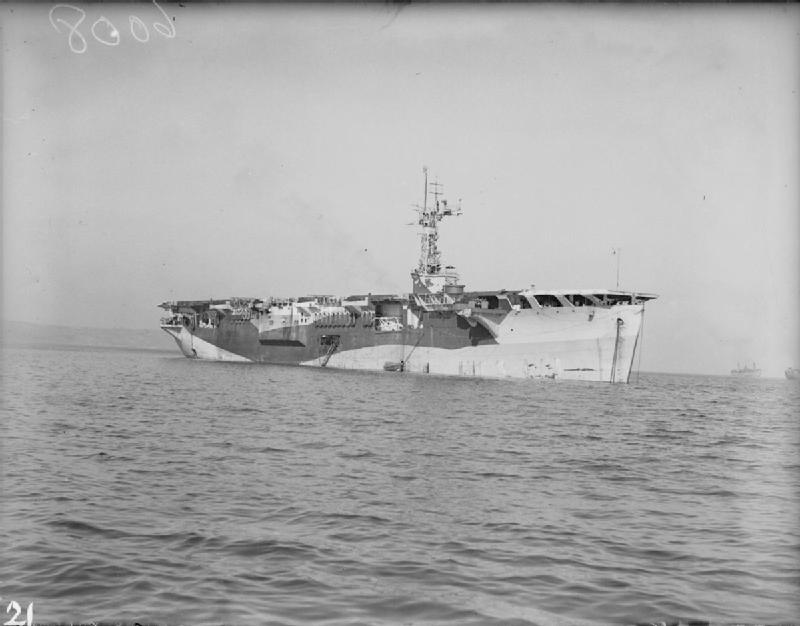
Vessel Wikidata
* This information from Wikidata is available under the Creative Commons Attribution-ShareAlike License
HMS Campania was an escort aircraft carrier of the Royal Navy, constructed at Harland & Wolff shipyards in Belfast, Northern Ireland. Originally laid down in 1941 as a refrigerated cargo ship intended for transporting lamb and mutton from New Zealand, she was requisitioned by the British government during construction and completed as an escort carrier, entering service in early 1944. The vessel was of a design similar to, but not identical with, the Nairana class. Throughout World War II, HMS Campania played a vital role in convoy escort duties and anti-submarine warfare in the Atlantic and Arctic theatres. Notably, in December 1944, her Swordfish aircraft from a detachment of 813 Squadron successfully sank the German U-boat U-365 while escorting the Arctic convoy RA 62. She survived the war without being scrapped or sold, unlike many of her sister ships, and was briefly used as an aircraft transport before being placed in reserve in December 1945. In 1951, HMS Campania was repurposed as the Festival Ship Campania for the Festival of Britain, serving as a floating exhibition hall. Repainted white and decorated with skeleton masts and bunting, she toured various UK ports, including Southampton, Dundee, Newcastle, and Glasgow, hosting exhibits divided into sections such as "Land of Britain," "Discovery," and "The People at Home." Following the festival, she was refitted at Birkenhead to serve as the command ship for Operation Hurricane, the British nuclear test conducted at the Monte Bello Islands in Australia in 1952. The refit included converting her into a mobile laboratory, workshop, and accommodation vessel, with facilities like a desalination plant to support the 1,500 personnel involved. She departed Portsmouth on 2 June 1952, calling at Gibraltar, Cape Town, Mauritius, and Fremantle en route to the test site. The test occurred on 3 October 1952, after which HMS Campania returned to the UK and was decommissioned in December 1952. She was sold for scrap and dismantled in Blyth in 1955, marking the end of her distinguished service.
This description has been generated using GPT-4.1-NANO based on the Vessel's wikidata information and then modified by ShipIndex.org staff.