
HMS Eurydice
1843 corvette
Vessel Wikidata
* This information from Wikidata is available under the Creative Commons Attribution-ShareAlike License
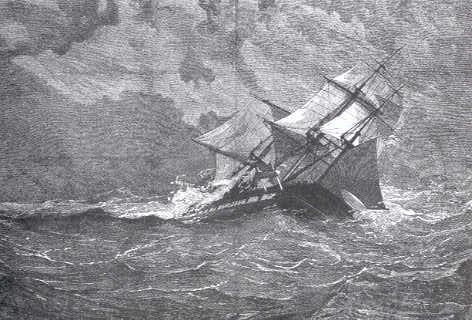
HMS Eurydice was a 26-gun Royal Navy corvette designed by Admiral the Hon. George Elliot. Constructed with a focus on speed and shallow draft, she was intended to operate effectively in shallow waters. Launched in 1843, her design featured a very fast hull with a shallow draught, making her suitable for stations such as North America, the West Indies, and the South African coast. Her early service saw her on the North American and West Indies station from 1843 to 1846 under her first captain, George Augustus Elliot. During this period, she was driven ashore near Havana in July 1845; her guns were removed to aid her refloating. Her second commission, from 1846 to 1850, was under Captain Talavera Vernon Anson and involved service on the South African station. She later served in the Crimean War, briefly operating in the White Sea, and returned to North American waters. By 1861, Eurydice was converted into a stationary training ship, reflecting her changing role within the Royal Navy. In 1877, she was refitted for seagoing service as a training vessel and recommissioned under Captain Marcus Hare. In 1878, while returning from Bermuda to Portsmouth, Eurydice encountered a severe snowstorm off the Isle of Wight. On 24 March 1878, she capsized and sank in Sandown Bay during a violent squall, resulting in the loss of most of her 319 crew and trainees. Only two survived. The disaster was attributed to the storm's sudden fury, intensified by her extreme hull design, which was later criticized for stability issues. The ship's loss prompted her immediate replacement by HMS Juno (later renamed HMS Atalanta), which also met a tragic end at sea. The wreck was refloated later in 1878 but was too badly damaged and was subsequently broken up. Her figurehead, carved by J. E. Hellyer, is preserved at the National Museum of the Royal Navy. The sinking of Eurydice remains a significant maritime tragedy, commemorated by memorials and noted in poetry, notably Gerard Manley Hopkins’ poem "The Loss of the Eurydice." Sightings of her phantom ship have persisted among sailors, with reports of ghostly appearances off the Isle of Wight.
This description has been generated using GPT-4.1-NANO based on the Vessel's wikidata information and then modified by ShipIndex.org staff.