
HMS Jaguar
1957 Leopard-class anti-aircraft defence frigate
Vessel Wikidata
* This information from Wikidata is available under the Creative Commons Attribution-ShareAlike License
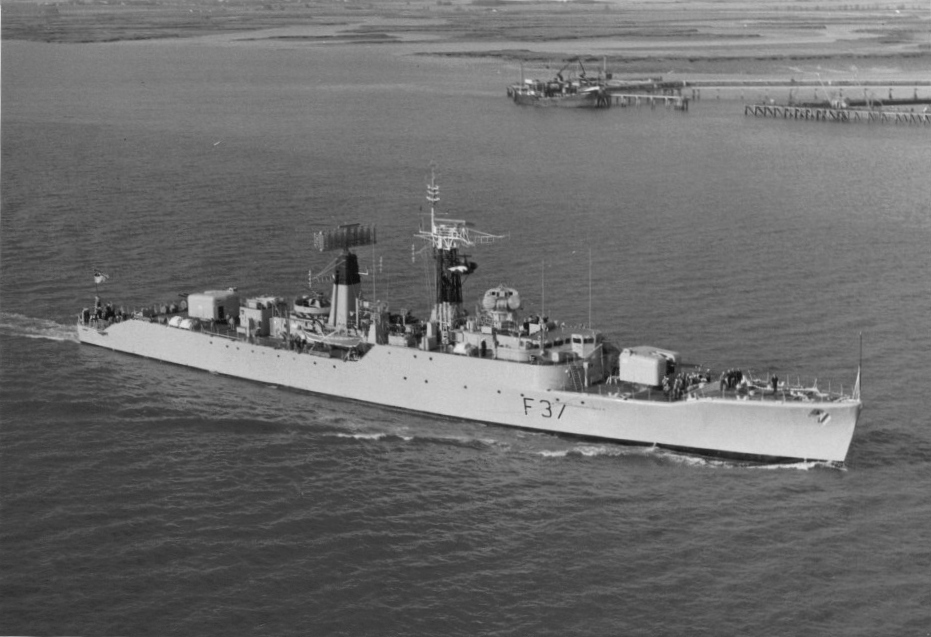
HMS Jaguar (F37) was a Leopard-class Type 41 anti-aircraft frigate of the British Royal Navy, notable for being the last frigate constructed by William Denny & Brothers. She was distinguished from her sister ships by the installation of controllable pitch propellers, enhancing maneuverability. The vessel's original armament comprised two twin 4.5-inch guns (Mark 6) and a twin STAAG mounting; however, the STAAG was soon replaced by a 40mm gun to improve her close-range defenses. Throughout her service life, HMS Jaguar underwent significant refits. In the mid-1960s, her long-range air warning radar was upgraded from Type 960 to Type 965, necessitating the replacement of her lattice mainmast with a plated structure to support the larger AKE1 aerial. The foremast was also modified, with the Type 293Q target designation radar replaced by the more advanced Type 993 radar, alongside new ESM (Electronic Support Measures) and SCCM (Shipborne Command and Control) equipment. An intended upgrade to Seacat missile systems was considered but ultimately not implemented to save costs. In January 1969, HMS Jaguar embarked on a world cruise, calling at numerous ports including Gibraltar, South Africa, Mombasa, Singapore, Hong Kong, New Zealand, Australia, Fiji, and Panama. During this voyage, she notably provided medical aid at Astove in the Seychelles. Her service included participation in the Second Cod War in 1973, during which she collided with the Icelandic gunboat Thor, damaging her bows and requiring repairs at Chatham Dockyard. She was later recommissioned in 1976 for the Third Cod War, during which she was fitted with heavy wooden sheathing to protect her bows and stern from collision damage. After a period in reserve, HMS Jaguar was sold to the Bangladesh Navy in 1978 for £2 million, where she was commissioned as BNS Ali Haider (F17). She served until her decommissioning in January 2014, marking a long career that spanned over four decades, with her name and pennant number subsequently taken by a different vessel.
This description has been generated using GPT-4.1-NANO based on the Vessel's wikidata information and then modified by ShipIndex.org staff.