
HMS Lancaster
1902 Monmouth-class armoured cruiser
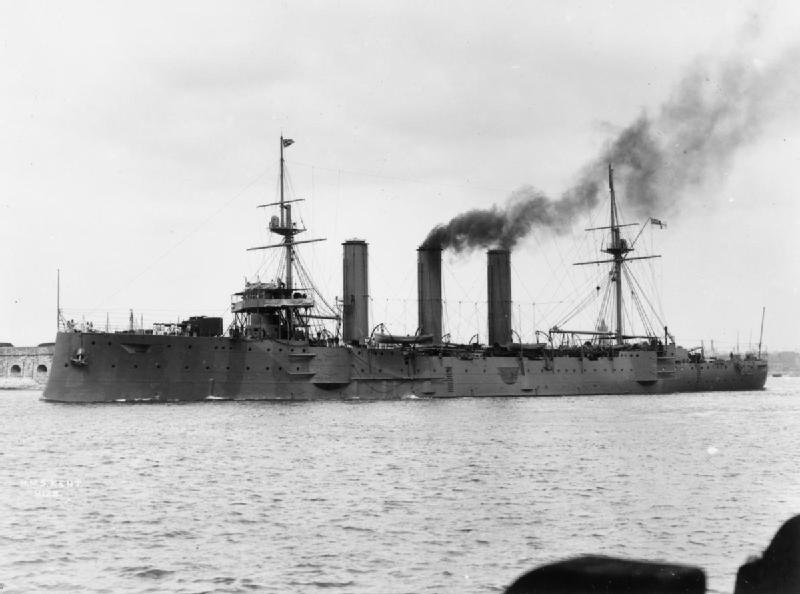
Vessel Wikidata
* This information from Wikidata is available under the Creative Commons Attribution-ShareAlike License
HMS Lancaster was a Monmouth-class armoured cruiser built for the Royal Navy, designed to protect British merchant shipping from fast enemy cruisers. Laid down at Armstrong Whitworth's Elswick shipyard on 4 March 1901 and launched on 22 March 1902, she was completed by 5 April 1904. The vessel measured approximately 463.5 feet in length, with a beam of 66 feet and a deep draught of 25 feet. Displacing around 9,800 long tons, Lancaster was powered by two 4-cylinder triple-expansion steam engines, supplemented by 31 Belleville boilers, collectively producing 22,000 indicated horsepower, which allowed her to reach speeds of up to 24 knots during sea trials. Her armament comprised fourteen 6-inch (152 mm) breech-loading guns, with four mounted in twin turrets fore and aft, and the remaining ten in casemates amidships. Additional armament included ten quick-firing 12-pounder guns for defense against torpedo boats, three 3-pounder Hotchkiss guns, and two submerged 18-inch torpedo tubes. The ship's armor featured a waterline belt of four inches amidships, with turrets and casemates protected by four inches of armor, and a protective deck varying from 0.75 to 2 inches thick. The conning tower was heavily armored with ten inches of protection. Initially assigned to the Mediterranean Fleet's 3rd Cruiser Squadron, Lancaster served there until 1912, after which she was placed in reserve. Recommissioned in 1913, she joined the North America and West Indies Station’s 4th Cruiser Squadron, and following the outbreak of World War I, she was tasked with hunting German commerce raiders and convoy protection. In 1915, she became part of the Grand Fleet’s 7th Cruiser Squadron, and in April 1916, she was transferred to the Pacific, eventually serving as the flagship of the Eastern Squadron in 1918. Lancaster’s service record reflects her importance in maintaining British maritime interests during the early 20th century and World War I. She was sold for scrap in March 1920, and her twin 6-inch guns are displayed outside the Historic Dockyard Museum in Stanley, Falkland Islands.
This description has been generated using GPT-4.1-NANO based on the Vessel's wikidata information and then modified by ShipIndex.org staff.