
HMS London
1656 second-rate ship of the line
Vessel Wikidata
* This information from Wikidata is available under the Creative Commons Attribution-ShareAlike License
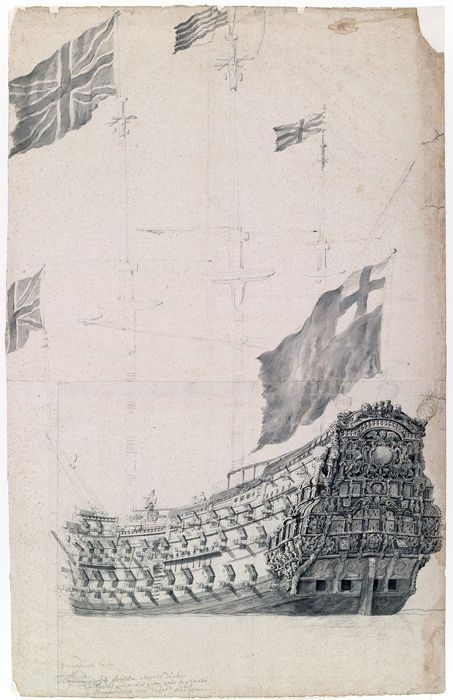
HMS London was a 76-gun second-rate ship of the line constructed at Chatham Dockyard by Master Shipwright Captain John Taylor, launched in June 1656. Designed as part of England’s 1654 Construction Programme, she featured a comprehensive armament layout with 13 pairs of gunports on the lower deck, 12 pairs on the middle deck, and 10 pairs on the upper deck—initially fitted with 64 guns, including demi-cannons, culverins, and demi-culverins, with later additions increasing her firepower. Her dimensions and precise tonnage are not specified, but her armament configuration indicates a formidable vessel suited for line-of-battle tactics. Commissioned in 1657 under Rear-Admiral Richard Stayner, HMS London first saw service in 1658 under Captain William Whitehorne. She played a notable role during the English Restoration, transporting James, Duke of York—later King James II—back to England aboard her as part of the fleet that brought Charles II from Holland in May 1660. Under Captain and later Vice-Admiral John Lawson, and subsequently serving as flagship for Admiral Edward Montagu, she was an active participant in the Royal Navy’s operations until her tragic end. On 7 March 1665, HMS London was lost in the Thames Estuary when an accidental explosion of her powder magazine caused her to blow up and sink rapidly, leaving wreckage scattered across the river. Samuel Pepys recorded the event, noting that over 300 crew members, including a woman, were killed, with only 24 survivors. The explosion's cause remains uncertain, though speculation pointed to the unsafe storage or quality of gunpowder. The wreck was rediscovered in 2005 and is now a protected site managed by Historic England, serving as an important maritime archaeological resource. The site has yielded numerous artifacts, including cannons and wooden objects, which offer insights into 17th-century naval warfare and shipbuilding. Notably, a near-perfect condition gun carriage was recovered in 2015 and is displayed at Southend Central Museum. Ongoing conservation efforts and excavations continue to enhance understanding of this historically significant vessel, which epitomizes England's naval power during a pivotal era.
This description has been generated using GPT-4.1-NANO based on the Vessel's wikidata information and then modified by ShipIndex.org staff.