
HMS Minotaur
1863 Minotaur-class ironclad
Vessel Wikidata
* This information from Wikidata is available under the Creative Commons Attribution-ShareAlike License
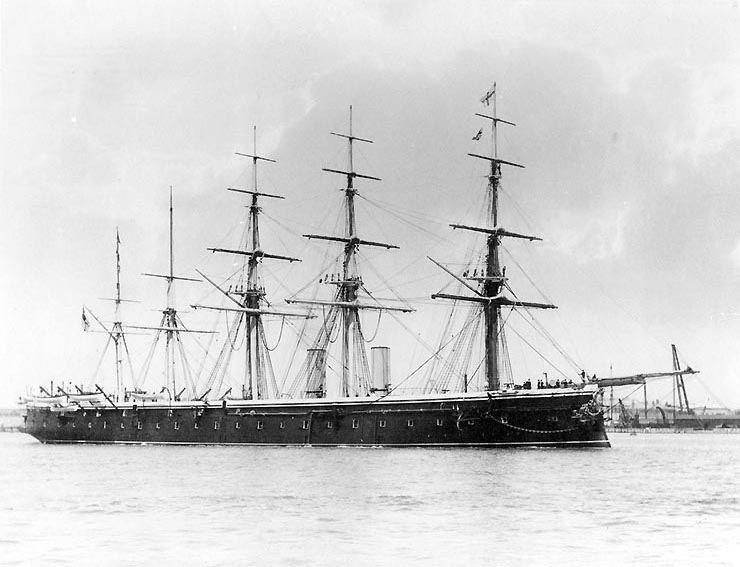
HMS Minotaur was the lead vessel of the Minotaur-class armoured frigates constructed for the Royal Navy during the 1860s. Built by Thames Ironworks in Blackwall, London, she was laid down on 12 September 1861, launched on 12 December 1863, and commissioned in April 1867, with her completion delayed nearly four years due to extensive experimentation with her armament and rigging. The ship cost approximately £478,855. Measuring 400 feet (121.9 meters) between perpendiculars and 411 feet (125.3 meters) overall, Minotaur displaced about 10,627 long tons (10,798 tonnes). Her broad beam was 58 feet 6 inches (17.8 meters), and she had a draft of 26 feet 10 inches (8.2 meters). The hull featured 15 watertight bulkheads, a double bottom beneath the engine and boiler rooms, and was armored with wrought iron tapering from 4.5 to 5.5 inches (114 to 140 mm), extending 5 feet 9 inches (1.8 meters) below the waterline, backed by 10 inches of teak. Powered by a two-cylinder trunk steam engine made by John Penn and Sons, she produced 6,949 indicated horsepower (5,182 kW) on trials, reaching speeds of 14.33 knots. Her steam came from ten fire-tube boilers operating at 25 psi. She carried 750 long tons of coal, enabling a range of 1,500 nautical miles at 7.5 knots. Reboilered in 1893, her speed was improved to 14 knots. The vessel was equipped with five masts and a sail area of over 32,000 square feet but was deemed a poor sailer, only making about 9.5 knots under sail and was later re-rigged as a barque. Armament initially consisted of rifled 110-pounder breech-loading guns, which were soon replaced by a mixture of nine-inch and seven-inch rifled muzzle-loading guns, complemented later by quick-firing guns and torpedo tubes. Her armor protected her entire sides with wrought iron, backed by 10 inches of teak, designed to defend her 50 guns. Minotaur served predominantly as the flagship of the Channel Squadron and participated in notable events such as Queen Victoria’s Golden Jubilee Fleet Review in 1887 and British naval operations off Egypt in 1882. She was also the first Royal Navy ship to receive a permanent electric searchlight in 1876. After her active career, she became a training ship, experiencing several renamings before being sold for scrap in 1922. Her long service reflected her importance in the evolution of armored frigates during the late 19th century.
This description has been generated using GPT-4.1-NANO based on the Vessel's wikidata information and then modified by ShipIndex.org staff.