
HMS Rodney
1833 Rodney-class second-rate ship of the line
Vessel Wikidata
* This information from Wikidata is available under the Creative Commons Attribution-ShareAlike License
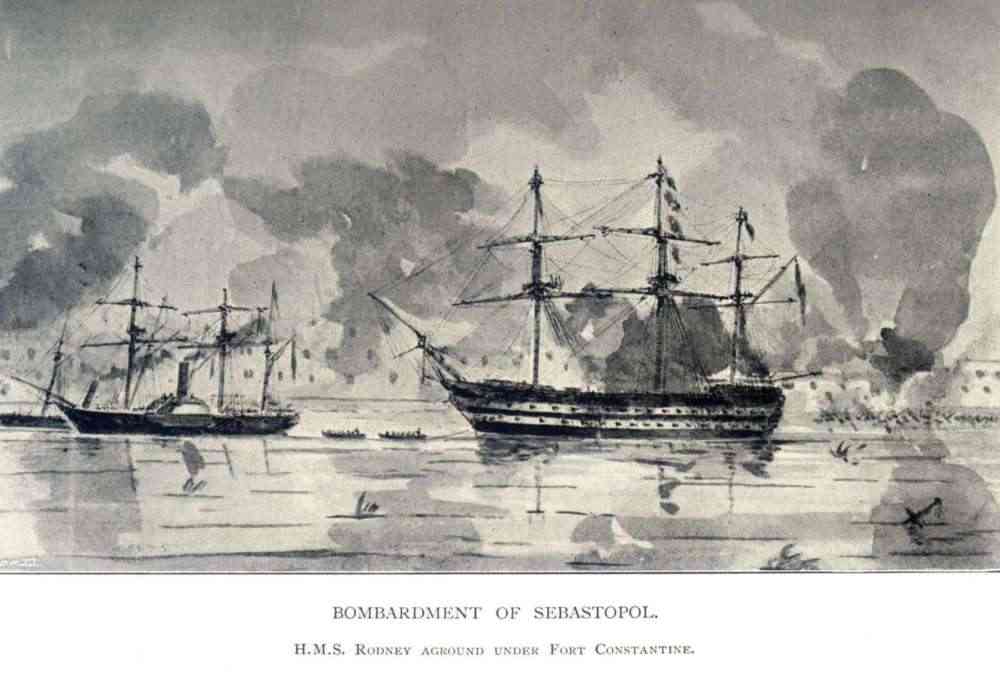
HMS Rodney was a second-rate ship of the line of the Royal Navy, launched in 1833 and dismantled in 1884. Constructed at Pembroke Dockyard based on Robert Seppings' design, she featured a two-deck configuration and was armed with 90 guns. Her length along the gun deck measured approximately 205.5 feet (62.6 meters), with an overall length of about 170 feet (51.8 meters) at the keel. The vessel's beam was 54 feet 5 inches (16.6 meters), and her depth of hold was 23 feet (7.0 meters). She displaced around 3,707 long tons (3,766 tonnes) and measured 2,625 tons burthen. Initially rigged as a full three-masted sailing ship, HMS Rodney carried a substantial sail area of over 28,000 square feet, accommodating a crew of 720 in peacetime and up to 820 during wartime. Her armament consisted of smoothbore muzzle-loading guns, including thirty-two 32-pounders and two 8-inch shell guns on each gun deck, with additional guns on the forecastle and quarterdeck, making her one of the most heavily armed ships of her time. These long guns were capable of long-range accuracy, giving her a combat advantage over contemporaries. In the early 1840s, modifications included raking the masts backward, which slightly reduced her sailing performance. Nonetheless, she proved to be a steady gun platform with a speed of around 11.4 knots early in her career. During the 1845 speed trials, she was found to be the fastest among her peers in a head sea. Her service record was extensive, primarily in the Mediterranean, with notable deployments in the Black Sea during the Crimean War. She was converted to steam power in 1860, becoming the last unarmoured wooden battleship in full commission, with her engine producing 2,246 indicated horsepower and capable of reaching 11.5 knots. HMS Rodney also served as a flagship in China under Vice-Admiral Henry Keppel and was notable for being the ship where William Hall, a future Victoria Cross recipient, began his naval career. Laid down with a robust diagonal bracing construction, her active service spanned over five decades, reflecting her significance in naval history before her decommissioning and breaking up in 1884.
This description has been generated using GPT-4.1-NANO based on the Vessel's wikidata information and then modified by ShipIndex.org staff.