
HMS Sabre
1918 S-class destroyer
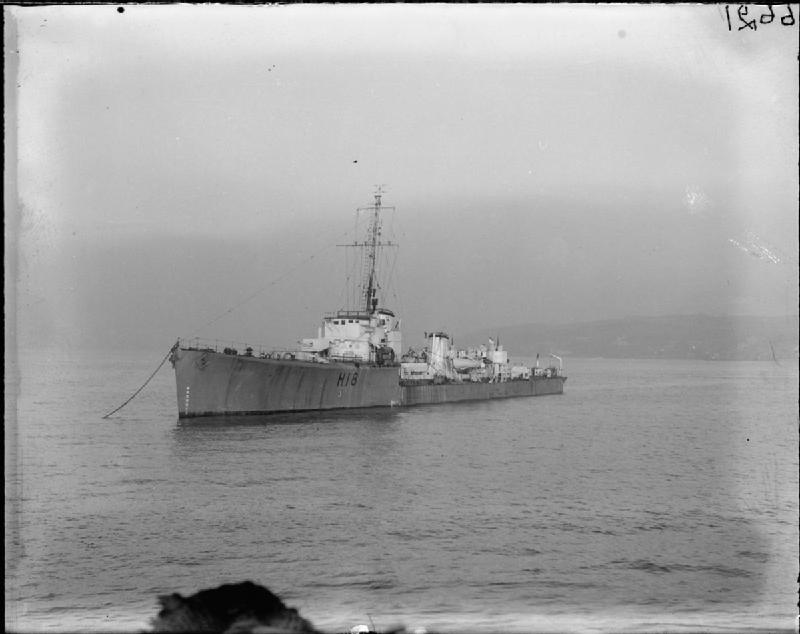
Vessel Wikidata
* This information from Wikidata is available under the Creative Commons Attribution-ShareAlike License
HMS Sabre was an Admiralty S-class destroyer of the Royal Navy, launched in September 1918. Built in Scotland by Alex Stephens and completed by Fairfield Shipbuilding and Engineering Company in Govan, she featured the typical design of early 20th-century destroyers, although specific dimensions are not provided in the source. Commissioned into fleet service in 1919, she was notably the first Royal Navy vessel to bear the name "Sabre." Initially serving post-World War I, Sabre was rendered surplus as newer destroyer designs emerged, leading to her de-militarization by the late 1930s and use as a target ship. However, with the outbreak of World War II, she was recommissioned in 1939 despite her age and limitations for Atlantic deployment. Her modifications included conversion into a convoy escort, removing her torpedo tubes and some guns, and adding anti-aircraft armaments—specifically, one 12-pounder and eight .5-inch AA guns—and radar types 286 and 291. Four single 20 mm AA mounts replaced earlier AA armaments later in the war. Sabre's wartime service was distinguished by her participation in critical operations. She was part of the Home Fleet at Scapa Flow at the war’s start, and soon after, she was assigned to convoy defense in the Western Approaches. She sustained severe damage in October 1939 when rammed by HMS Jervis Bay at Rosyth but was repaired by May 1940. During the Dunkirk evacuation, she played a prominent role, making ten round trips and rescuing approximately 5,765 soldiers—one of the highest totals for any individual ship. Her captain was awarded the D.S.O., and crew members received various honors. Throughout 1940-1941, Sabre participated in multiple evacuation operations, including 'Operation Cycle' and 'Operation Aerial,' rescuing thousands of troops from France and Alderney. She was involved in several convoy escort missions, including anti-submarine actions off Malin Head and rescue operations for torpedoed ships, such as SS Volendam and the tanker Cardita. Notable incidents included her near disaster at Tory Island in December 1940, where she was heavily damaged during a rescue attempt, and her involvement in rescue operations off St Kilda in early 1942. Throughout the war, Sabre primarily served in Atlantic convoy defense, attached to escort groups based in Liverpool and Iceland. After the war, she was placed on the disposal list and sold for scrap in November 1945, arriving at Grangemouth in 1946. Her service record demonstrates her resilience and vital contribution to key maritime operations during both world wars.
This description has been generated using GPT-4.1-NANO based on the Vessel's wikidata information and then modified by ShipIndex.org staff.