
HMS Sandfly
1872 Beagle-class schooner
Vessel Wikidata
* This information from Wikidata is available under the Creative Commons Attribution-ShareAlike License
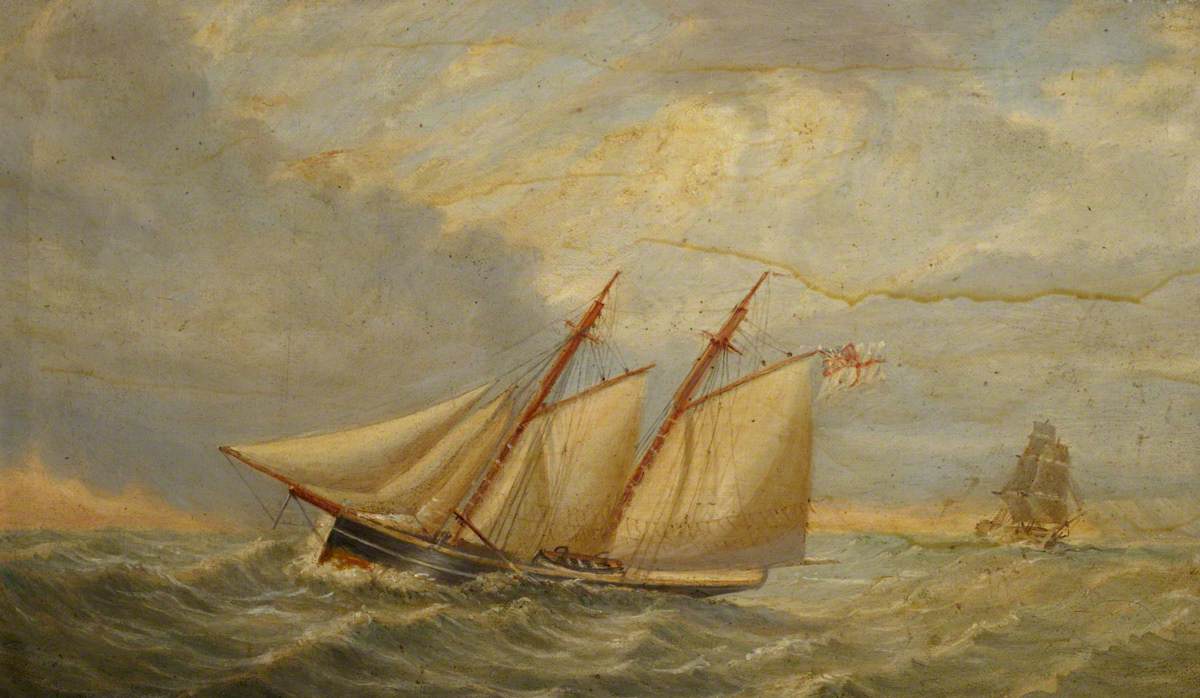
HMS Sandfly was a schooner of the Royal Navy, constructed by John Cuthbert at Millers Point, New South Wales, and launched on 5 December 1872. The vessel was primarily involved in operations across the South Pacific, serving on the Australia Station at Sydney from 1873. As a schooner, her design would have featured a two-masted rig typical of the period, suitable for coastal and survey work, though specific dimensions are not provided in the source. Her initial service included anti-blackbirding patrols, exemplified by her seizure of the brig Aurora in October 1873 for violating the Imperial Labour Act. Her early voyages took her among the South Sea Islands, and she undertook surveying missions in New Guinea in 1874. During this period, she encountered a storm that damaged her rudder, requiring assistance from HMS Basilisk to return to Sydney. Notably, the Sandfly was involved in a skirmish at the Santa Cruz Islands in September 1874, where she escaped an attack by islanders in canoes, a reflection of the tensions and violence in the region during that era. In 1880, under Lieutenant James Bower, she conducted hydrographic surveys in the Solomon Islands and New Guinea. Her survey work was marred by tragedy when her party was attacked on Nggela Island, resulting in the deaths of Bower and four sailors. The Sandfly responded to the incident by conducting retaliatory actions, including burning canoes and attacking villages, which led to a British naval blockade and diplomatic efforts to apprehend the attackers. After her transfer to the Tongan government in 1883, she operated mainly between Tonga and New Zealand, serving as a 76-ton schooner. Her later years involved supply missions, such as providing provisions to Niuatoputapu following a volcanic eruption in 1886. Sold in 1889 to Captain W T Fitzpatrick of Sydney, her service continued in the Pacific until her wrecking on 3 December 1892 at Makira, Solomon Islands. The vessel was driven onto rocks by the tide while loading copra, with her crew safely evacuating. The wreck marked the end of her operational life, while her service history reflects the maritime and colonial activities of the period, including survey work, anti-slavery enforcement, and regional trade.
This description has been generated using GPT-4.1-NANO based on the Vessel's wikidata information and then modified by ShipIndex.org staff.