
HMS Thane
1943 Ruler-class escort carrier
Vessel Wikidata
* This information from Wikidata is available under the Creative Commons Attribution-ShareAlike License
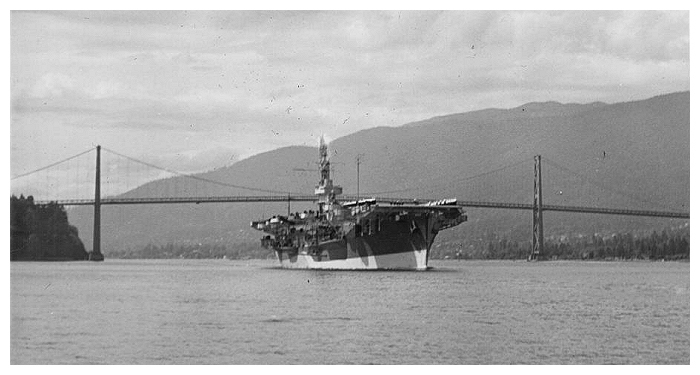
HMS Thane (D48) was a Ruler-class escort carrier operated by the Royal Navy during World War II. Originally constructed as the USS Sunset (CVE-48), a Bogue-class escort carrier for the United States Navy, the vessel was laid down on 23 February 1943 by Seattle-Tacoma Shipbuilding in Tacoma, Washington. She was launched on 15 July 1943 and redesignated CVE-48 before being transferred to the United Kingdom under the Lend-Lease agreement on 19 November 1943, when she was commissioned as HMS Thane. The ship measured an overall length of 492 feet 3 inches (150.0 meters), with a beam of 69 feet 6 inches (21.2 meters) and a draught of 25 feet 6 inches (7.8 meters). Her propulsion system consisted of a steam turbine powered by two boilers, connected to a single shaft, generating 9,350 shaft horsepower, which enabled her to reach speeds of up to 16.5 knots. The vessel's complement was approximately 646 men. HMS Thane's flight deck featured a small combined bridge and flight control on the starboard side, two aircraft lifts measuring 43 by 34 feet (13.1 by 10.4 meters), a single aircraft catapult, and nine arrestor wires for launching and recovering aircraft. Her hangar below the flight deck measured 260 by 62 feet (79.2 by 18.9 meters). She could carry up to twenty-four aircraft, including fighters such as Grumman Martlet, Vought F4U Corsair, or Hawker Sea Hurricane, and anti-submarine aircraft like Fairey Swordfish or Grumman Avenger. HMS Thane primarily operated in the North Atlantic, protecting convoys and ferrying aircraft to the European Theater. Notably, her last voyage in December 1944 brought the first helicopters to the UK, with nine Sikorsky R-4B Hoverflies flown from Norfolk, Virginia. On 15 January 1945, while ferrying aircraft in the Irish Sea, Thane was torpedoed by the German U-boat U-1172, suffering severe damage, including the loss of her starboard aft 5-inch gun and sponson, disabled propulsion, and the loss of ten crew members. She was taken to Gare Loch in Scotland, examined, and declared a constructive total loss. Subsequently, she was returned to U.S. custody in May 1945, and by October, she was designated for disposal and eventually scrapped. Her service and her role in introducing helicopters to the UK mark her as a notable vessel in wartime maritime history.
This description has been generated using GPT-4.1-NANO based on the Vessel's wikidata information and then modified by ShipIndex.org staff.