
SMS Hindenburg
1915 Derfflinger-class battlecruiser
Vessel Wikidata
* This information from Wikidata is available under the Creative Commons Attribution-ShareAlike License
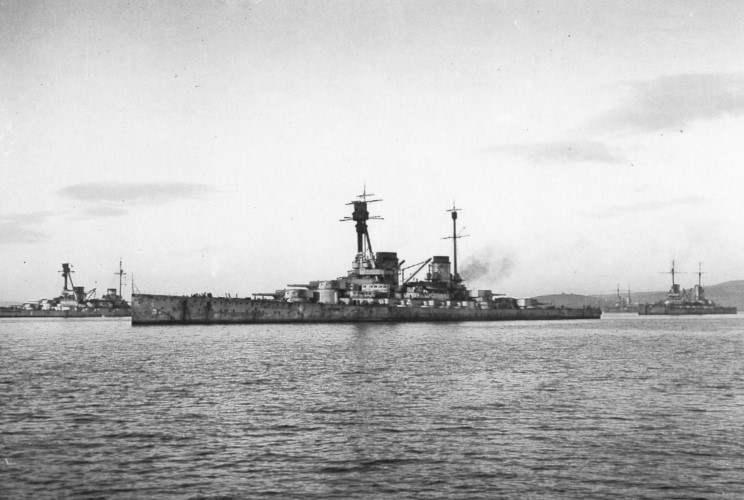
SMS Hindenburg was a Derfflinger-class battlecruiser built for the German Kaiserliche Marine during the early 20th century. As the third and final vessel of her class, she was constructed at the Kaiserliche Werft shipyard in Wilhelmshaven, with her keel laid in June 1913 and launched in August 1915. She measured approximately 212.8 meters overall in length, making her slightly larger than her sister ships, with a beam of 29 meters and a draft ranging from about 9.2 to 9.6 meters. Her displacement was around 26,947 metric tons normally, increasing to up to 31,500 tons when fully laden. The vessel had a crew complement of approximately 1,112 officers and men, with additional personnel when serving as flagship. Hindenburg was powered by four steam turbines driving four screws, utilizing fourteen coal-fired and eight oil-fired boilers, rated at 72,000 metric horsepower, achieving a top speed of about 27 knots. Her range at 14 knots was roughly 6,100 nautical miles. The ship's primary armament consisted of eight 30.5 cm (12-inch) guns mounted in four twin turrets, equipped with improved Drh LC/1913 mounts that allowed greater elevation and range than earlier models. Her secondary battery included fourteen 15 cm guns and four 60 cm torpedo tubes. Armor protection featured a central belt up to 300 mm thick, with turret faces of 270 mm, and a conning tower armor of 300 mm. Despite her impressive specifications, Hindenburg's service was brief. Commissioned in May 1917, she served as the flagship of I Scouting Group during the final year of World War I, participating in limited fleet operations and patrols but seeing no major engagement. Notably, she was involved in the German fleet's last planned sortie, which was canceled due to mutiny among the crews. After Germany's defeat, Hindenburg was interned at Scapa Flow in November 1918 and was ultimately scuttled there in June 1919 to prevent her seizure by the Allies. Raised in 1930, she was scrapped over the subsequent two years, marking the end of her maritime career. Her construction and limited wartime service underscore her role as a late-war German capital ship, representing the technological advancements and strategic considerations of the Imperial Navy during World War I.
This description has been generated using GPT-4.1-NANO based on the Vessel's wikidata information and then modified by ShipIndex.org staff.