
SMS Derfflinger
1913 Derfflinger-class battlecruiser
Vessel Wikidata
* This information from Wikidata is available under the Creative Commons Attribution-ShareAlike License
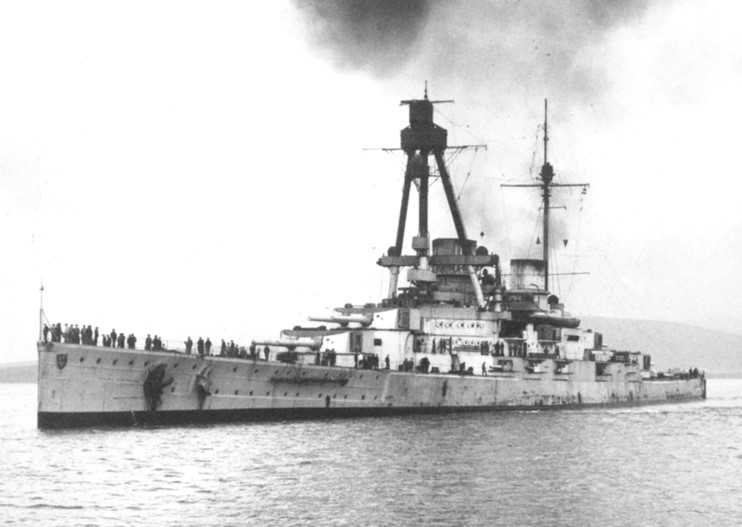
SMS Derfflinger was a formidable German battlecruiser constructed in the early 1910s, serving during World War I as the lead ship of her class. She measured approximately 210.4 meters in overall length, with a beam of 29 meters and a draft of 9.2 meters. Displacing around 26,600 tons normally and up to 31,200 tons at full load, Derfflinger was powered by two pairs of high- and low-pressure steam turbines driving four screw propellers, fed by fourteen coal-fired water-tube boilers. Her engines produced about 63,000 metric horsepower, enabling a top speed of 26.5 knots and a cruising range of 5,600 nautical miles at 14 knots. Armament-wise, Derfflinger was equipped with eight 30.5 cm (12 inch) guns in four superfiring turrets, making her the most heavily armed German battlecruiser of her time. Her secondary battery comprised twelve 15 cm guns in casemates, with additional anti-torpedo boat guns and four submerged torpedo tubes. The ship's armor scheme included a 300 mm (11.8 inch) thick armored belt protecting vital areas like magazines and machinery, with main gun turrets armored with 270 mm faces, and a conning tower with 300 mm walls. Launched from Blohm & Voss in Hamburg, Derfflinger was laid down in March 1912 and completed shortly after the outbreak of WWI in 1914. She participated in numerous significant operations, including raids on the British coast, the Battle of Dogger Bank, and the Battle of Jutland. At Jutland, she distinguished herself by helping sink the British battlecruisers HMS Queen Mary and Invincible, and endured severe damage, including hits from heavy shells, which resulted in casualties of 157 men, earning her the nickname "Iron Dog." She sustained multiple hits during the battle, notably a 38 cm shell that caused extensive damage. After repairs, Derfflinger continued patrol and support duties in the North Sea and Baltic, participating in various raids and engagements until the end of the war. She was interned at Scapa Flow following Germany’s defeat and was scuttled in June 1919 to prevent her seizure by the Allies. Raised in 1939, she remained afloat upside down until 1946, after which she was scrapped by 1948. Her significance lies in her role as a key element of German naval power during WWI, exemplifying the design advancements and operational resilience of early 20th-century battlecruisers.
This description has been generated using GPT-4.1-NANO based on the Vessel's wikidata information and then modified by ShipIndex.org staff.