
Ocean Telegraph
American cargo ship
Vessel Wikidata
* This information from Wikidata is available under the Creative Commons Attribution-ShareAlike License
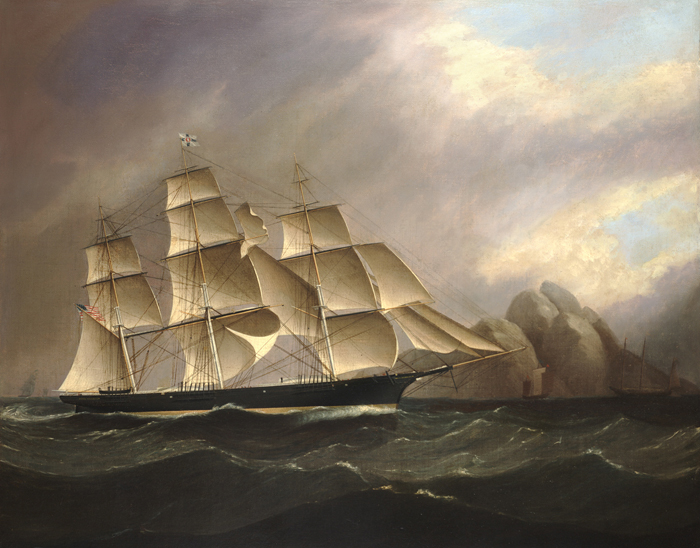
The Ocean Telegraph was a notable clipper ship launched in Massachusetts on March 29, 1854, designed by the renowned naval architect Samuel Hartt Pook. Built by James O. Curtis at Medford, her construction featured a wooden hull with a length of 212.9 feet (64.9 meters), a beam of 40.4 feet (12.3 meters), and a depth of 25.2 feet (7.7 meters). She was a full-rigged ship, characterized by her sharp, streamlined hull painted black with copper sheathing at the bottom, typical of clipper ships of her era. Her design emphasized speed and elegance, with a raked bow adorned with a carved female figure and a figure of Neptune on her stern, embodying both beauty and performance. Her rigging comprised three masts, and her tonnage was 1,495 BM and 1,244 Moorsom System. Initially serving the route between New York and San Francisco, Ocean Telegraph was part of Reed, Wade & Co.'s "Shippers Line of San Francisco Packets," completing her voyages in impressive times, with her fastest outward passage from New York to San Francisco taking 105 days and 20 hours. She participated in notable races, such as her 1859–60 race against the Great Republic, which she won in 109 days, reinforcing her reputation as a swift clipper. Throughout her service, she made multiple fast passages, with a total of eight voyages to San Francisco with cargo, often nearing record times, and a remarkable record from Callao to New York in 58 days, believed to be the fastest on record. In 1862, she carried Peruvian guano from San Francisco to Queenstown. Her original American ownership ended in 1863 when she was sold to UK interests, renamed Light Brigade, and registered in London. Under British ownership, she primarily transported migrants and troops between the UK, Australia, and New Zealand, making numerous voyages with about 400 passengers each, including soldiers' families and assisted migrants. Her rig was converted to a barque in 1876, and she was used as a coal hulk at Gibraltar from 1883, reflecting her transition from an active sailing vessel to auxiliary service. She remained registered in Gibraltar until at least 1923, with her last known record being a coal hulk owned by the British Coal Company. Her long service life and varied roles underscore her maritime significance and adaptability across different periods and uses.
This description has been generated using GPT-4.1-NANO based on the Vessel's wikidata information and then modified by ShipIndex.org staff.