
Russian ironclad Sevastopol
Imperial Russian Navy's 58-gun wooden frigate
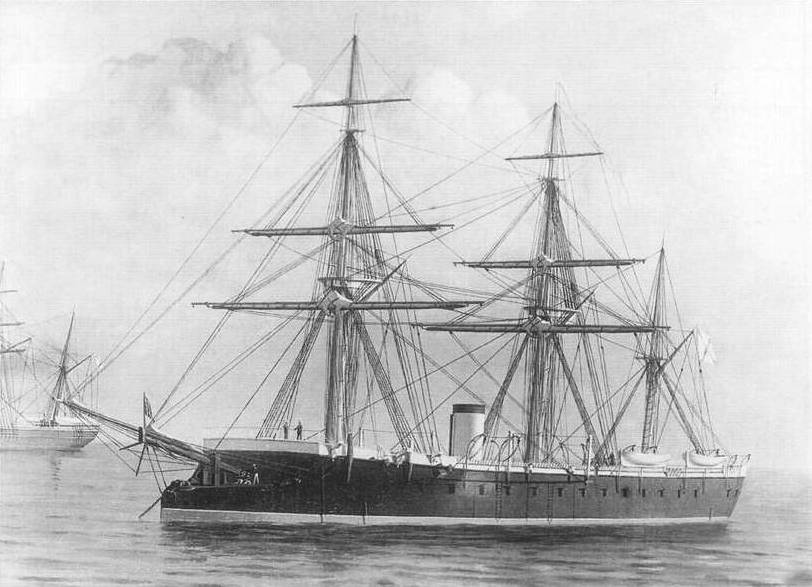
Vessel Wikidata
* This information from Wikidata is available under the Creative Commons Attribution-ShareAlike License
The Russian ironclad Sevastopol was a notable warship of the Imperial Russian Navy, constructed during the early 1860s. Originally ordered as a 58-gun wooden frigate, she was reconfigured mid-construction into a 32-gun armored frigate, reflecting the transition to ironclad warfare. Laid down on September 7, 1860, in Kronstadt, she was launched on August 12, 1864, and commissioned on July 8, 1865. Sevastopol measured approximately 300 feet (91.4 meters) in length between perpendiculars, with a beam of 50 feet 4 inches (15.3 meters). Her draft was 22 feet 2 inches (6.8 meters) forward and 24 feet (7.3 meters) aft, and she displaced about 6,135 long tons (6,233 tons). The vessel featured a blunt iron ram at her bow and was considered a good sea boat, with a crew complement of around 607 officers and enlisted men. Her propulsion system consisted of a horizontal return-connecting-rod steam engine from Izhora Works, driving a single two-bladed propeller. During sea trials, her engine produced approximately 3,088 indicated horsepower, reaching a maximum speed of nearly 14 knots. She was schooner-rigged, with three masts, and carried up to 400 long tons of coal, although her endurance is not specified. Initially armed with the most powerful Russian guns—mainly 7.72-inch (196 mm) 60-pounder smoothbore guns and four 36-pounders—her armament was revised during her conversion to an ironclad. By the late 1860s, she carried a mix of 60-pounder guns and 8-inch rifled guns, with further updates in 1877 to include 14 eight-inch guns, along with additional rifled guns on her upper deck. Her armor comprised wrought iron extending 5 feet 2 inches below the waterline, with thickness varying from 4.5 inches amidships to thinner armor near her ends, backed by substantial teak planking for reinforcement. The Sevastopol served exclusively with the Baltic Fleet, primarily as a heavy frigate and later as a training ship from 1880. She was decommissioned in 1885 and remained until she was sold for scrap in 1897. Her service highlights a period of significant naval transition, marking her as a representative example of early Russian ironclad design and adaptation.
This description has been generated using GPT-4.1-NANO based on the Vessel's wikidata information and then modified by ShipIndex.org staff.