
RMS Queen Mary
retired British ocean liner
Vessel Wikidata
* This information from Wikidata is available under the Creative Commons Attribution-ShareAlike License
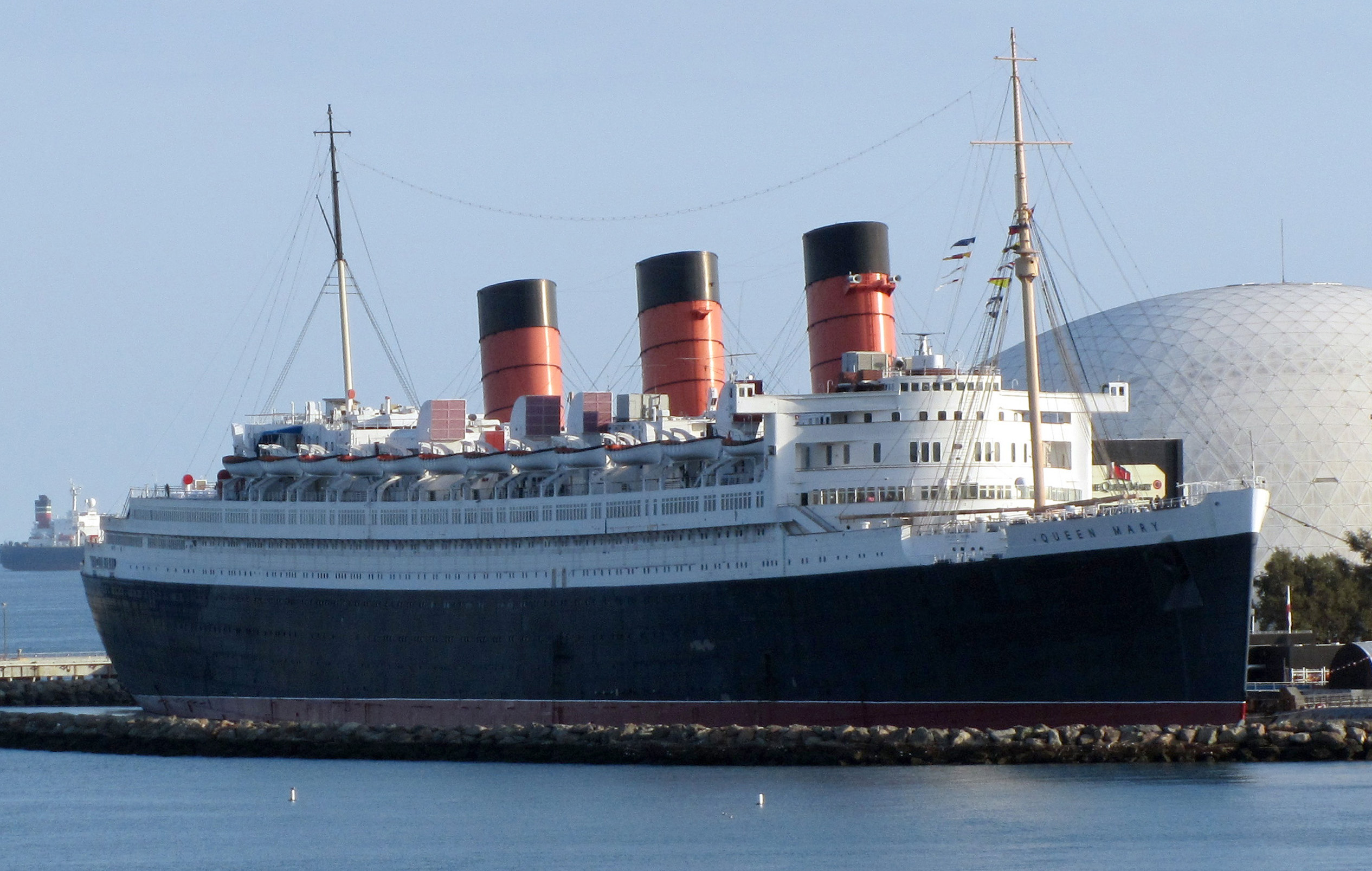
The RMS Queen Mary is a historic British ocean liner built by John Brown & Company in Clydebank, Scotland, with a length of approximately 1,019 feet (310.7 meters) and a gross register tonnage (GRT) of around 80,774. She was designed to serve on Cunard Line's North Atlantic route, operating from 1936 to 1967. The vessel's construction began in December 1930, with work interrupted during the Great Depression but later completed with a British government loan and a merger with White Star Line to form Cunard-White Star Line. Launched by Queen Mary herself on 26 September 1934, she featured 24 Yarrow boilers generating steam at 400 psi and 700°F, powering four Parsons turbines that delivered 212,000 shp to her four propellers, enabling her to reach speeds over 32 knots during trials. Queen Mary’s design was traditional, with an Art Deco interior, including luxurious public rooms, two indoor swimming pools, libraries, beauty salons, and a Jewish prayer room—an inclusive feature for the time. Her main dining room was a grand, three-story space, and she featured amenities like paddle tennis courts and a music studio, reflecting her status as a premier passenger liner. She initially held the Blue Riband, awarded for the fastest transatlantic crossing, capturing the record from the German liner Normandie in 1936 and retaking it in 1938, holding it until 1952. During World War II, Queen Mary was converted into a troopship, earning the nickname "Grey Ghost" for her painted hull and remarkable speed, often carrying over 16,600 troops in a single voyage—setting records for the most passengers transported at once. She played a vital role in the war effort, carrying over 800,000 troops and participating in significant operations, including the planning of D-Day. Notably, she accidentally sank the escort cruiser HMS Curacoa in 1942, resulting in a significant loss of life. After the war, she resumed civilian service, continuing as a vital transatlantic route until the jet age diminished demand. She was retired in 1967 and relocated to Long Beach, California, where she was repurposed as a hotel, museum, and event space. Extensive modifications turned her into a static attraction, with many interior spaces converted into hotel rooms and banquet facilities. The vessel has faced ongoing preservation challenges, including severe deterioration and costly repairs, but remains a symbol of maritime history and engineering significance. Today, she is listed on the US National Register of Historic Places and continues to serve as a cultural landmark and tourist destination.
This description has been generated using GPT-4.1-NANO based on the Vessel's wikidata information and then modified by ShipIndex.org staff.