
Turtle
first combat submersible; United States, 1775


Vessel Wikidata
* This information from Wikidata is available under the Creative Commons Attribution-ShareAlike License
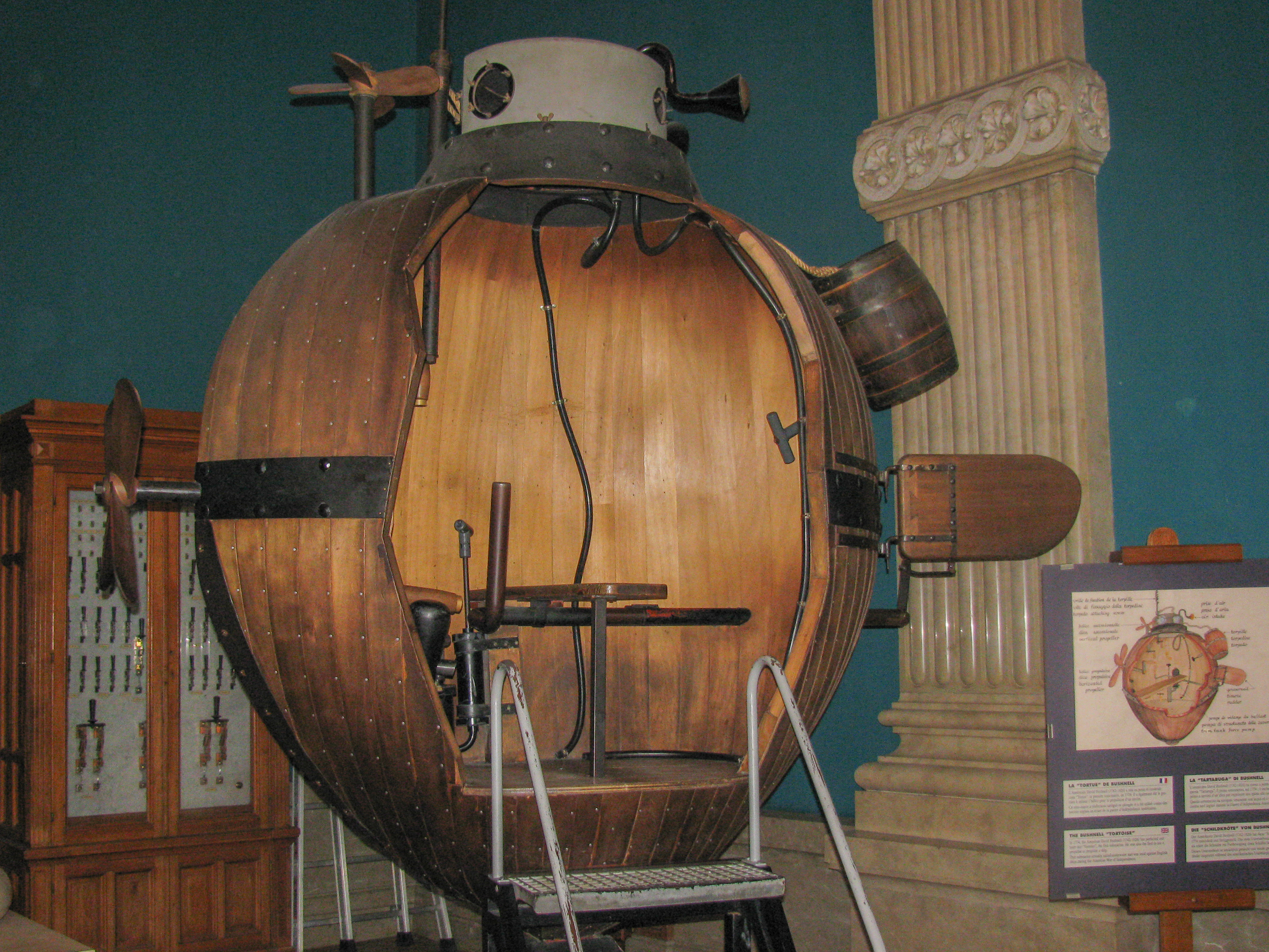
The Turtle, also known as the American Turtle, was the world's first documented combat submarine, constructed in 1775 by American inventor David Bushnell during the American Revolutionary War. Its design was revolutionary, featuring a compact, manned hull approximately 10 feet (3.0 meters) long, 6 feet (1.8 meters) tall, and 3 feet (0.9 meters) wide. The vessel's hull consisted of two oak shells shaped like a barrel and reinforced with heavy wrought-iron hoops, reminiscent of a tortoise shell, which provided buoyancy and structural integrity. The hull was covered with tar and steel bands to ensure watertightness. The Turtle's construction involved multiple artisans, including Bushnell's brother Ezra and ship's carpenter Phineas Pratt, with key mechanical components likely crafted by Isaac Doolittle, a skilled New Haven mechanic. Its propulsion system was manually operated, utilizing hand-cranked and pedal-powered brass propellers—an innovative feature being the first known use of a watercraft propeller. The vessel was equipped with small glass portholes for natural light and bioluminescent foxfire to aid navigation in darkness. It was designed to dive by flooding a bilge tank and resurface using a hand pump, with a maximum operational time of about 30 minutes and a top speed of roughly 3 mph (4.8 km/h). The vessel's weight was augmented with 200 pounds (91 kg) of lead ballast, which could be released to increase buoyancy. The Turtle was intended for covert attacks against British ships, notably to attach explosive charges beneath enemy vessels in New York Harbor. Its most famous attempt was on September 7, 1776, when Sergeant Ezra Lee piloted it toward HMS Eagle, but the attack was unsuccessful due to operational difficulties and environmental challenges. The vessel was lost shortly after when the British sank the sloop carrying it in October 1776, and its final fate remains unknown, though Bushnell reported salvaging the craft. Despite its limited success, the Turtle marked a pivotal advancement in underwater warfare, pioneering technologies like the hand-cranked propeller and underwater explosive devices. Its legacy endures through numerous replicas and its influence on subsequent submarine development, symbolizing a significant American contribution to maritime military innovation.
This description has been generated using GPT-4.1-NANO based on the Vessel's wikidata information and then modified by ShipIndex.org staff.