
USCGC Yamacraw
Vessel Wikidata
* This information from Wikidata is available under the Creative Commons Attribution-ShareAlike License
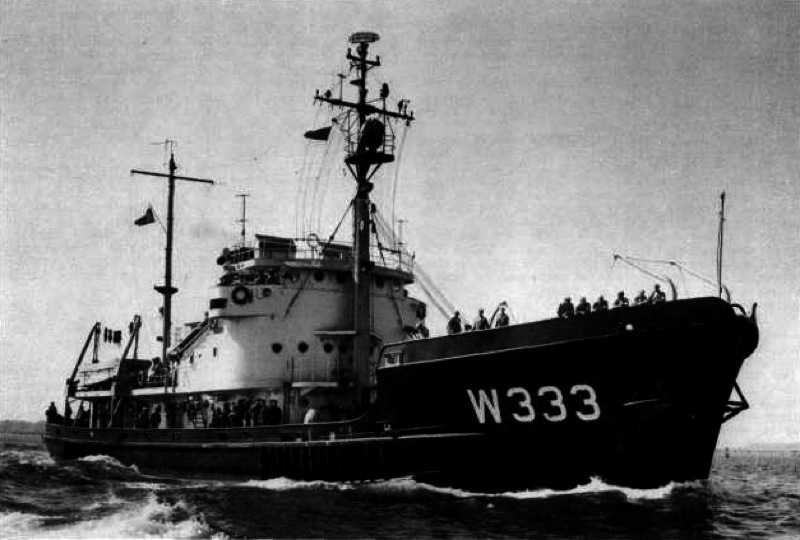
The USCGC Yamacraw (WARC-333) was a notable cable repair ship with a multifaceted service history spanning the U.S. Army, Navy, Coast Guard, and scientific research institutions. Originally built for the Army Mine Planter Service as U.S. Army Mine Planter Maj. Gen. Arthur Murray (MP-9), the vessel was launched in 1942 by the Marietta Manufacturing Company in Point Pleasant, West Virginia. It measured approximately 188 feet in length overall, with a beam of 37 feet and a draft of 11 feet 6 inches. Propelled by two 600-horsepower Skinner Uniflow Marine Engines, the ship was equipped to carry large amounts of mine control cable and multiple mine groups on deck, designed for planting and tending controlled minefields along the U.S. coast. In 1945, the vessel was acquired by the Navy and converted into an auxiliary minelayer, commissioning as USS Trapper (ACM-9). During World War II, Trapper operated in the Pacific theater, supporting minesweeping gear repairs in Japanese waters after arriving there post-war. Following the war, the ship returned to the United States in 1946 and was transferred to the Coast Guard, where it was renamed Yamacraw (WARC-333). As a Coast Guard vessel, Yamacraw served primarily as a cable layer, supporting Navy and Coast Guard cable operations until 1959. Between 1957 and 1958, the vessel was loaned to the Woods Hole Oceanographic Institution for oceanographic research, including acoustical and geophysical studies in the Atlantic and Mediterranean. Notably, it was equipped with a 600-foot thermistor chain for temperature profiling at various depths, facilitating research into ocean acoustics and thermal structures, including the Strait of Gibraltar. Reacquired by the Navy in 1959, Yamacraw was commissioned as USS Yamacraw (ARC-5), serving as a cable repair and research vessel along the U.S. East Coast and supporting scientific projects for the Office of Naval Research and Bell Telephone Laboratories. The ship's contributions to oceanographic and acoustic research were significant, including testing towing systems for deep-sea instrumentation. Decommissioned in 1965, the vessel was sold for scrap in 1967 and scrapped in 1969, marking the end of its versatile service life.
This description has been generated using GPT-4.1-NANO based on the Vessel's wikidata information and then modified by ShipIndex.org staff.