
USS Bienville
gunboat of the United States Navy
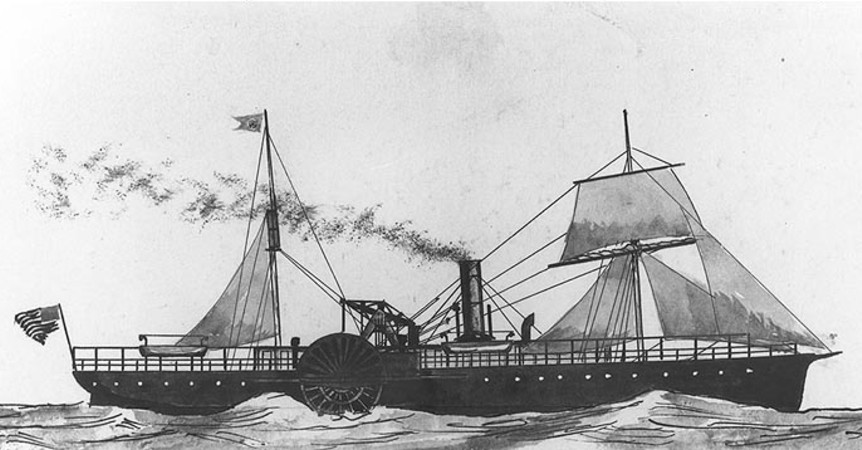
Vessel Wikidata
* This information from Wikidata is available under the Creative Commons Attribution-ShareAlike License
The USS Bienville was a wooden side-wheel paddle steamer built in Brooklyn, New York, in 1860. Displacing approximately 1,558 long tons (1,583 metric tons), the vessel featured a two-masted sail-steamer configuration, with a walking beam steam engine that powered a pair of side paddle wheels. This design allowed her to operate effectively both under steam and sail, making her versatile for Civil War naval operations. Acquired by the Union Navy in August 1861, shortly after the outbreak of the American Civil War, the USS Bienville was commissioned on October 23, 1861, under the command of Commander Charles Steedman. Her early service saw her participating in expeditions that resulted in the seizure of key naval bases at Port Royal and Beaufort, South Carolina. She operated along the Atlantic coast for over a year, engaging in blockading duties and supporting Union efforts to control Confederate waterways. During this period, Bienville contributed to the capture of several Confederate positions along the Georgia and Florida coasts and played a role in neutralizing blockade runners, including the steamship Stettin on May 24, 1862, and Patras on May 27, 1862. In 1863, the USS Bienville was transferred to the Gulf of Mexico, where she continued her blockade activities. Notably, she supported the capture of the entrances to Mobile Bay, Alabama, on August 5, 1864. Later, she operated off the coast of Texas, enforcing the blockade of Galveston. One significant event occurred on the night of February 7, 1865, when Bienville, along with the USS Princess Royal, sent a boat party into Galveston Bay to seize schooners loaded with cotton. During this operation, they targeted the Wren, a ship built by Laird, Son & Co., which had run aground and was moored inside the harbor, and successfully captured two other schooners, Pet and Annie Sophia. Following the Civil War, the USS Bienville was decommissioned and spent about two years in reserve before being sold in October 1867. She continued to serve as a commercial steamship until her destruction by fire at Watling Island, Bahamas, on August 15, 1872. The fire resulted in the loss of her crew, including the Spanish artist Fortunato Arriola, who was aboard at the time. The USS Bienville's service highlights her role in Union naval blockades and coastal operations, contributing significantly to the maritime efforts of the Civil War.
This description has been generated using GPT-4.1-NANO based on the Vessel's wikidata information and then modified by ShipIndex.org staff.