
USS Catawba
1864 Canonicus-class monitor
Vessel Wikidata
* This information from Wikidata is available under the Creative Commons Attribution-ShareAlike License
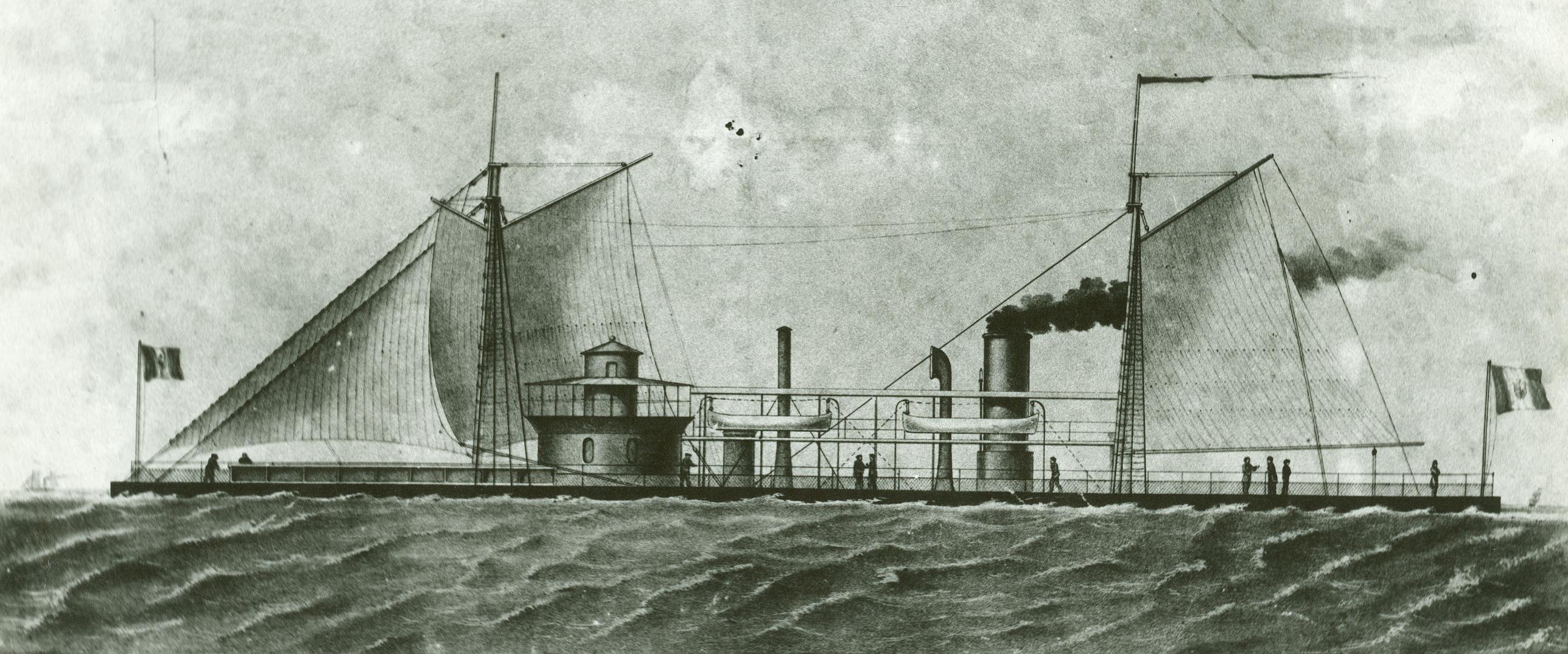
The USS Catawba was a Canonicus-class monitor built for the Union Navy during the American Civil War, measuring 235 feet (72 meters) in length overall, with a beam of 43 feet 8 inches (13.31 meters) and a maximum draft of 13 feet 6 inches (4.11 meters). The vessel displaced approximately 2,100 long tons (2,130 metric tons) and had a tonnage of 1,034 tons burthen. Crew capacity was around 100 officers and enlisted men. Her propulsion system consisted of a two-cylinder horizontal Ericsson vibrating-lever steam engine that drove a single propeller, powered by four Stimers horizontal fire-tube boilers. This setup generated about 320 indicated horsepower, giving her a top speed of approximately 8 knots (15 km/h). The ship carried 140–150 long tons (140–150 metric tons) of coal, enabling her to sustain her operations over extended periods. The Catawba's armament featured two massive 15-inch (381 mm) Dahlgren smoothbore muzzle-loading guns mounted in a single turret. Each gun weighed around 43,000 pounds (19,500 kg) and could fire shells weighing 350 pounds (159 kg) up to 2,100 yards (1,920 meters) at a +7° elevation. Her armor was formidable for her time, with five layers of 1-inch wrought iron plates on the sides, backed by wood, and ten layers of 1-inch armor on the turret and pilot house. The deck was protected by 1.5-inch (38 mm) armor, and additional protective measures included an 8-inch (200 mm) band around the turret's base and 6-foot (1.8-meter) sections of armor on the funnel's base. A notable feature was the "rifle screen," a 0.5-inch (13 mm) armor barrier atop the turret to shield crew members from sniper fire. Constructed by Alexander Swift & Company in Cincinnati, Ohio, the Catawba was laid down in 1862 and launched on April 13, 1864. Her construction experienced delays due to design modifications based on Civil War combat lessons, including increased armor thickness and hull deepening. She was completed after the Civil War ended and was laid up until sold in 1868. Subsequently, she was sold to the Peruvian Navy, renamed BAP Atahualpa, and transported to South America. During her service with Peru, Atahualpa saw action defending Callao during the War of the Pacific. When Lima was captured by Chilean forces in 1881, she was scuttled to avoid capture. The ship was later raised and used as a storage hulk until she was scrapped in the early 20th century. Her maritime significance lies in her transition from a Civil War-era monitor to an active participant in South American naval conflicts, exemplifying the durability and adaptability of Civil War monitor designs in later regional conflicts.
This description has been generated using GPT-4.1-NANO based on the Vessel's wikidata information and then modified by ShipIndex.org staff.