
USS Spuyten Duyvil
torpedo boat of the United States Navy
Vessel Wikidata
* This information from Wikidata is available under the Creative Commons Attribution-ShareAlike License
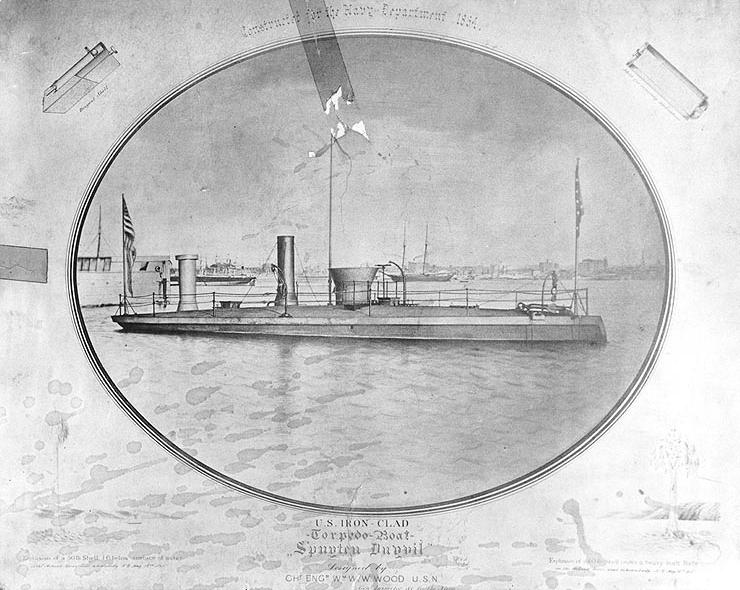
The USS Spuyten Duyvil was a distinctive screw steam torpedo boat constructed during the American Civil War, primarily designed for deploying torpedoes—an early form of naval mine—against Confederate vessels. She was initially named Stromboli and was designed under the supervision of Captain William W. Wood, the U.S. Navy’s Chief Engineer. Built rapidly in New Haven, Connecticut, with construction completed in approximately three months following a contract dated June 1, 1864, the vessel was launched and commissioned within a remarkably short period, though exact dates remain unconfirmed. Constructed of timber, the Spuyten Duyvil featured a heavily armored hull, with her sides and deck protected by one-inch-thick iron plating. Her overall length was 84 feet 2 inches, with a beam of 20 feet 8 inches, and a depth of hold of nearly 10 feet. When fully equipped, her draft increased from about 4 feet to approximately 7 feet 5 inches, and she displaced around 207 tons. She was powered by a single four-bladed screw propeller driven by engines built by Mallory and Co. in Mystic, Connecticut. Her designed speed was approximately 9 miles per hour, although this was reduced to about 3.5 to 4 miles per hour when she was submerged and prepared for combat, operating noiselessly to avoid detection. The vessel's distinctive bow incorporated two hinged iron flaps that could open to allow the projection of torpedoes through a specialized tube system. Her torpedo-laying machinery, devised by Captain Wood and built by the Clute Brothers, enabled her to place and fire explosive devices containing black powder designed to float into enemy vessels’ hulls or beneath obstructing Confederate obstructions in the James River. The torpedoes, which contained about 60 pounds of powder, were released via a complex system of guided tubes, tanks, and mechanical linkages allowing rapid firing—up to one every three minutes. During her service, Spuyten Duyvil operated along the James River, supporting Union efforts during key campaigns, including the Battle of Trent's Reach. She played a vital role in clearing obstructions after the fall of Richmond and helped facilitate President Lincoln’s passage upriver. After the war, she continued to clear river obstructions and was later used for developmental and experimental work until she was placed in ordinary at the New York Navy Yard in 1866. She was removed from the Navy list in 1880, marking the end of her active maritime career. Her innovative design and wartime service highlight her significance in the development of early naval torpedo tactics and technology.
This description has been generated using GPT-4.1-NANO based on the Vessel's wikidata information and then modified by ShipIndex.org staff.