
USS Vanderbilt
gunboat of the United States Navy
Vessel Wikidata
* This information from Wikidata is available under the Creative Commons Attribution-ShareAlike License
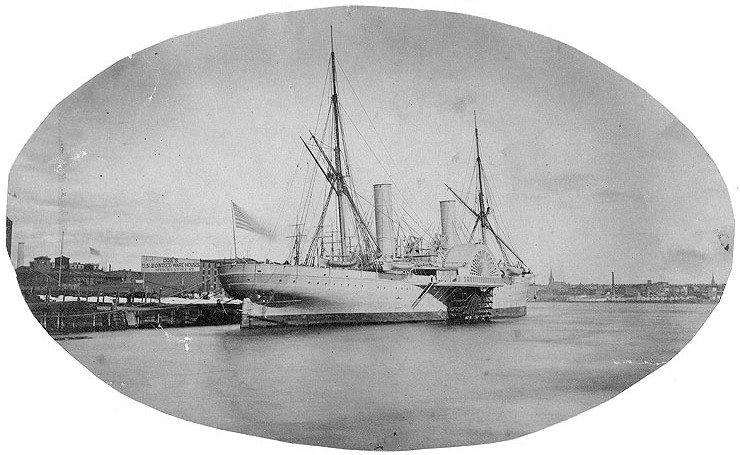
The USS Vanderbilt was a notable 3,360-ton steamship originally built as a transatlantic passenger and mail steamer by Jeremiah Simonson of Greenpoint, Long Island, in 1856-1857. Characterized by her high speed of 14 knots, she was designed for swift transoceanic travel and mail delivery. The vessel’s early career was marred by an incident on October 31, 1858, when she ran aground in the Weser River en route from Bremen to Southampton and New York. Despite being severely leaky, she was refloated and repaired. During the American Civil War, Vanderbilt was requisitioned by the Union Navy, initially offered by her owner, Commodore Cornelius Vanderbilt. She was transformed into a warship, with her bow reinforced with concrete and iron plating, and was armed with a heavy battery of 15 guns. Her military role commenced in Hampton Roads, Virginia, where she was intended as a ram against Confederate ironclads, though this plan was not executed. Vanderbilt's service included patrolling the Atlantic and conducting extended searches for Confederate commerce raiders, notably CSS Alabama. Her operations took her across the West Indies, South America, Africa, and Europe, during which she captured several blockade runners, including the British steamer Peterhoff and the bark Saxon. She also served as the flagship of Commodore Charles Wilkes' Flying Squadron. Despite her efforts, she never sighted Alabama. In late 1864, Vanderbilt participated in the blockade off Wilmington and in the unsuccessful first attack on Fort Fisher. After the war, she transported recruits to the Gulf of Mexico, towed Confederate vessels, and served as a receiving ship. Post-war, she was part of a squadron circumnavigating South America, reaching San Francisco in 1866. She then transported Queen Emma of Hawaii to Honolulu in 1867. Decommissioned in 1867, Vanderbilt was sold in 1873, converted into a clipper-rigged vessel named Three Brothers, and engaged mainly in the grain trade. She remained active until 1899, when she was finally sold for scrap. Her career exemplifies the versatility and evolving role of mid-19th-century steamships in both civilian and military contexts.
This description has been generated using GPT-4.1-NANO based on the Vessel's wikidata information and then modified by ShipIndex.org staff.