
USS Winnebago
1863 Milwaukee-class monitor
Vessel Wikidata
* This information from Wikidata is available under the Creative Commons Attribution-ShareAlike License
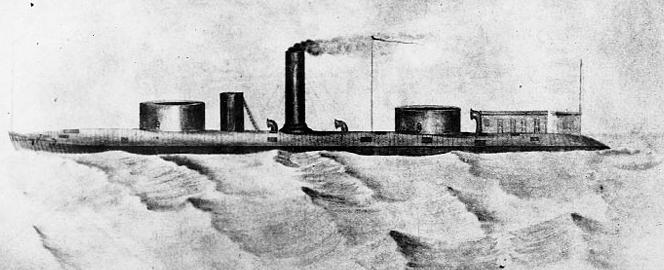
The USS Winnebago was a Milwaukee-class river monitor constructed for the Union Navy during the American Civil War. Measuring 229 feet (69.8 meters) in length with a beam of 56 feet (17.1 meters), she had a shallow draft of 6 feet (1.8 meters) and a depth of hold of 8 feet 6 inches (2.6 meters). Displacing approximately 1,300 long tons and with a burthen of 970 tons, she was crewed by 138 officers and enlisted men. Her propulsion system comprised two 2-cylinder horizontal non-condensing steam engines, each driving two propellers powered by seven tubular boilers, capable of reaching a top speed of about 9 knots (17 km/h). She carried 156 long tons (159 tonnes) of coal for her steaming needs. Winnebago's armament consisted of four 11-inch Dahlgren smoothbore, muzzle-loading guns, mounted in two twin-gun turrets—one designed by James Eads and the other by John Ericsson. Each gun weighed around 16,000 pounds (7,300 kg) and could fire shells weighing 136 pounds (61.7 kg) up to a range of approximately 3,650 yards (3,340 meters). The ship’s armored protection included eight layers of wrought iron 1-inch (25 mm) plates shielding her turrets, while her hull featured three layers of 1-inch plates backed by 15 inches (380 mm) of pine. The deck was heavily cambered, constructed from iron plates 0.75 inches (19 mm) thick, and her pilothouse was protected by 3 inches (76 mm) of armor. Launched on July 4, 1863, and commissioned on April 27, 1864, Winnebago was initially assigned to the Mississippi River Squadron. She participated notably in the Battle of Mobile Bay on August 5, 1864, where her turrets were briefly jammed but she still managed to fire 56 shells during the engagement, damaging Confederate defenses and assisting in the sinking of the CSS Tennessee. She was lightly damaged during the battle, with 19 hits but no casualties. Following the battle, Winnebago supported Union efforts in the Mobile Campaign and the subsequent blockade of Mobile Bay, including a successful mission to cut a Confederate telegraph cable. She also saw service in river operations until the surrender of Confederate forces. After the war, Winnebago was placed in reserve, renamed Tornado in 1869, then reverted to her original name later that year, and finally sold in 1874. Her service exemplifies the strategic use of armored river monitors in controlling key waterways and supporting Union military campaigns during the Civil War.
This description has been generated using GPT-4.1-NANO based on the Vessel's wikidata information and then modified by ShipIndex.org staff.