
USS Oneota
1864 Canonicus-class monitor
Vessel Wikidata
* This information from Wikidata is available under the Creative Commons Attribution-ShareAlike License
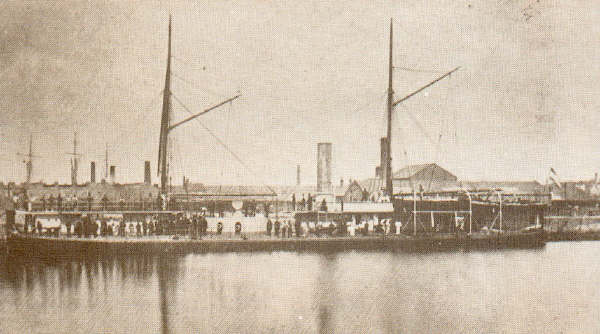
The USS Oneota was a Canonicus-class monitor built for the Union Navy during the American Civil War. She measured 225 feet (68.6 meters) in length overall, with a beam of 43 feet 3 inches (13.2 meters) and a maximum draft of 13 feet 6 inches (4.1 meters). The vessel displaced approximately 2,100 long tons (2,100 metric tons) and had a tonnage of 1,034 tons burthen. Her crew comprised about 100 officers and enlisted men. Powered by a two-cylinder horizontal vibrating-lever steam engine producing 320 indicated horsepower, Oneota could reach a top speed of 8 knots (15 km/h). Steam was generated by two Stimers horizontal fire-tube boilers, and she carried 140–150 long tons (140–150 metric tons) of coal. Her armament consisted of two 15-inch (381 mm) Dahlgren smoothbore muzzle-loading guns mounted in a single turret, each weighing approximately 43,000 pounds (20,000 kg), capable of firing shells up to 2,100 yards (1,900 meters). The ship’s armor included five layers of 1-inch wrought iron plates on the hull's sides, backed by wood, and ten layers of 1-inch plates on the turret and pilot house. The deck was protected by 1.5-inch armor, with additional armor around the turret base and funnel to prevent damage from shells and fragments. A unique feature was a 0.5-inch armor "rifle screen" installed atop the turret for crew protection against snipers. Constructed by Alexander Swift & Co. in Cincinnati, Ohio, the USS Oneota was laid down in 1862, launched on May 21, 1864, and completed in June 1865. Her construction was delayed by design modifications, including increasing armor thickness, deepening the hull for buoyancy, and relocating the turret for better balance. After initial fitting out, she was laid up and later moved to various locations, including Cairo, Illinois, and New Orleans. In 1867, she was transferred to Swift & Co. and subsequently sold to Peru in 1868, where she was renamed BAP Manco Cápac. As Manco Cápac, she served in the Peruvian Navy, notably defending Arica during the War of the Pacific. She engaged Chilean forces in 1880 before being scuttled to prevent her capture when Chilean troops took the port. Her wreck was rediscovered in 1960, lying 3 miles off the San José River mouth at about 15.7 meters depth. The remains have been heavily looted and corroded, but her historical significance remains as a representative example of Civil War-era monitor design and her later service highlights the global reach of American-built naval vessels.
This description has been generated using GPT-4.1-NANO based on the Vessel's wikidata information and then modified by ShipIndex.org staff.