
Bathyscaphe Trieste
deep sea scientific submarine


Vessel Wikidata
* This information from Wikidata is available under the Creative Commons Attribution-ShareAlike License
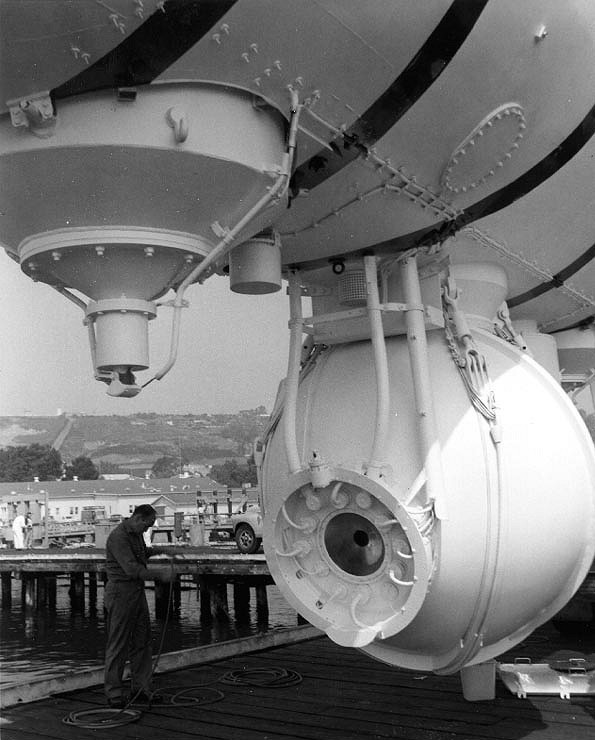
The Trieste is a deep-diving research bathyscaphe originally designed by Swiss scientist Auguste Piccard and constructed in Italy in 1953. Its physical structure comprises a steel pressure sphere, which was initially built by Acciaierie Terni and later replaced in 1958 by a more robust Krupp steel sphere, capable of withstanding pressures exceeding those at the deepest ocean depths. The pressure sphere measures approximately 2.16 meters (7.1 feet) in diameter, with walls 127 millimeters (5 inches) thick, and is equipped with a single acrylic glass porthole for external observation, reinforced to withstand immense underwater pressures. The vessel's hull, constructed by Cantieri Riuniti dell'Adriatico in the Free Territory of Trieste, is over 15 meters long and features buoyancy tanks filled with gasoline to enable it to ascend and descend. Ballast is managed through iron shot stored in conical hoppers, which can be released electrically to control buoyancy during dives. The bathyscaphe is powered by batteries, with life support and communication systems including a closed-circuit rebreather system for oxygen and soda-lime scrubbers for carbon dioxide removal. Trieste's operational history includes its first launch near the Isle of Capri in the Mediterranean, where it was operated by the French Navy until 1958, after which it was acquired by the U.S. Navy for $250,000. Its most notable achievement occurred on 23 January 1960, when piloted by Jacques Piccard and Don Walsh, the bathyscaphe reached the bottom of Challenger Deep in the Mariana Trench—approximately 10,916 meters (35,814 feet) below sea level—marking the first crewed descent to the ocean's deepest point. During this historic dive, the vessel experienced structural stresses, including a cracked Plexiglas window, and crew members observed the sea floor, noting diatomaceous ooze and purported flatfish, though some observations have been questioned. After extensive use in deep-sea exploration, including searches for the USS Thresher in 1963, Trieste was decommissioned in 1966. It remains preserved and on display at the National Museum of the United States Navy in Washington, D.C., serving as a symbol of pioneering underwater exploration and technological achievement.
This description has been generated using GPT-4.1-NANO based on the Vessel's wikidata information and then modified by ShipIndex.org staff.