
HMS Bounty
1784 survey ship
Vessel Wikidata
* This information from Wikidata is available under the Creative Commons Attribution-ShareAlike License
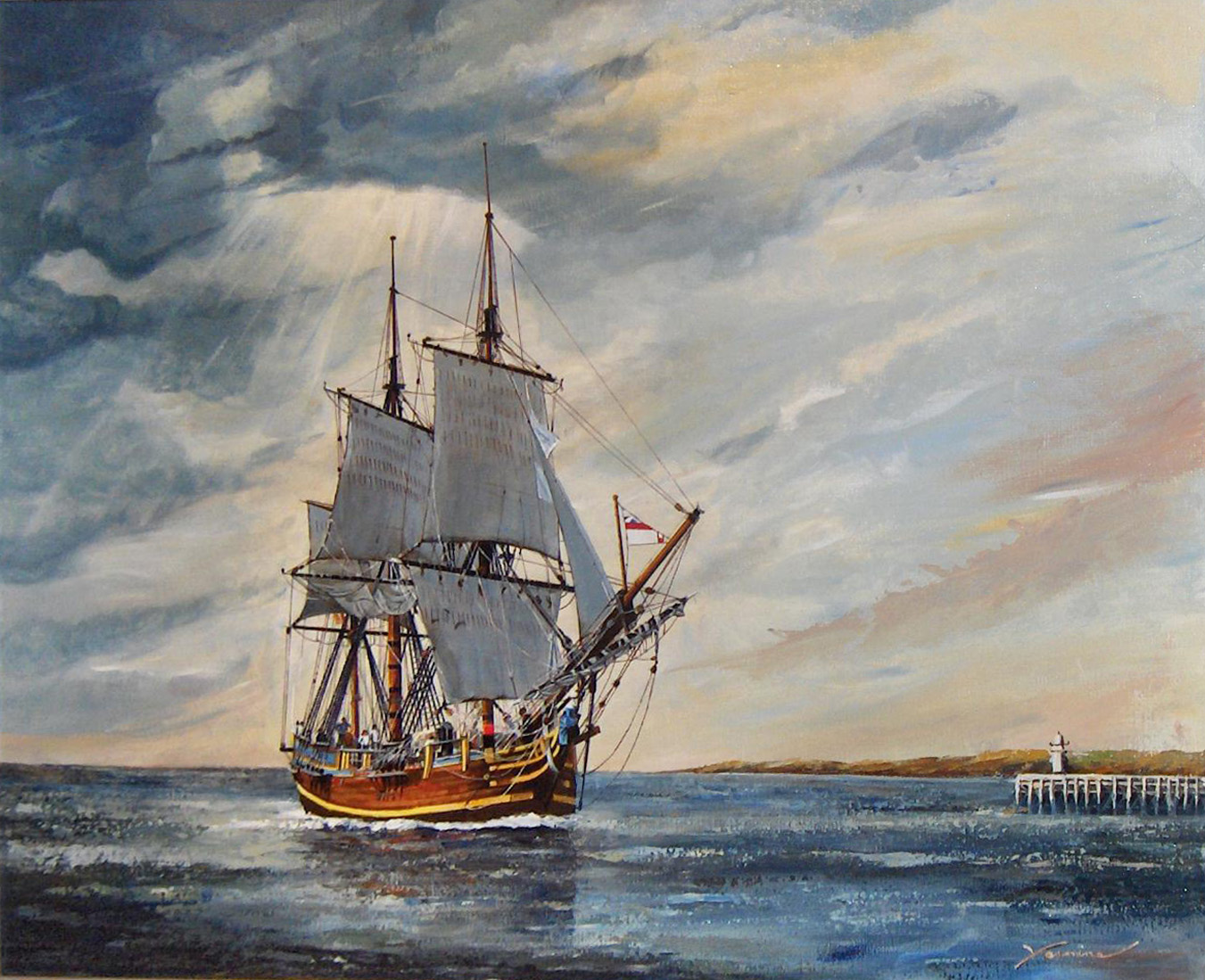
HMS Bounty, originally the collier Bethia built in 1784 at Blaydes Yard in Hull, Yorkshire, was a small, full-rigged vessel of 215 tons. Purchased by the Royal Navy in May 1787 for £1,950, she was subsequently refitted for a botanical expedition to acquire breadfruit plants from Tahiti. The ship was equipped with three masts and carried four 4-pounder cannons along with ten swivel guns, making her a relatively modest but versatile vessel suited for her specialized mission. During her conversion at Deptford, her great cabin was adapted to house the breadfruit plants, and the upper deck was fitted with gratings to facilitate the expedition. Under the command of Lieutenant William Bligh, aged 33, Bounty embarked on her historic voyage on 23 December 1787. The ship's complement consisted of 46 men, including Bligh, two civilian gardeners, and Royal Navy personnel. She was a relatively small but full-rigged ship, designed for maneuverability and long ocean passages. Bounty's service is most notable for her role in the 1789 breadfruit expedition, which took her across the South Pacific to Tahiti. She spent five months there collecting and preparing over a thousand breadfruit plants. The voyage was arduous, with Bligh demonstrating considerable navigation skill, especially during the infamous mutiny that occurred near Tonga in April 1789. Mutineers, led by Fletcher Christian, seized control of the vessel and set Bligh and his loyalists adrift in a small boat, an event that became legendary. Following the mutiny, the mutineers eventually settled on Pitcairn Island, where they burned Bounty to prevent detection in January 1790. The ship's remains are believed to be partially visible in Bounty Bay today, with artifacts such as a rudder, nails, and a ship's anchor recovered in later years. The vessel's story, from her construction to her pivotal role in one of maritime history's most famous mutinies, underscores her maritime significance as both a vessel of exploration and a symbol of rebellion.
This description has been generated using GPT-4.1-NANO based on the Vessel's wikidata information and then modified by ShipIndex.org staff.