
USS Congress
1799 frigate, one of the original six frigates of the United States Navy
Vessel Wikidata
* This information from Wikidata is available under the Creative Commons Attribution-ShareAlike License
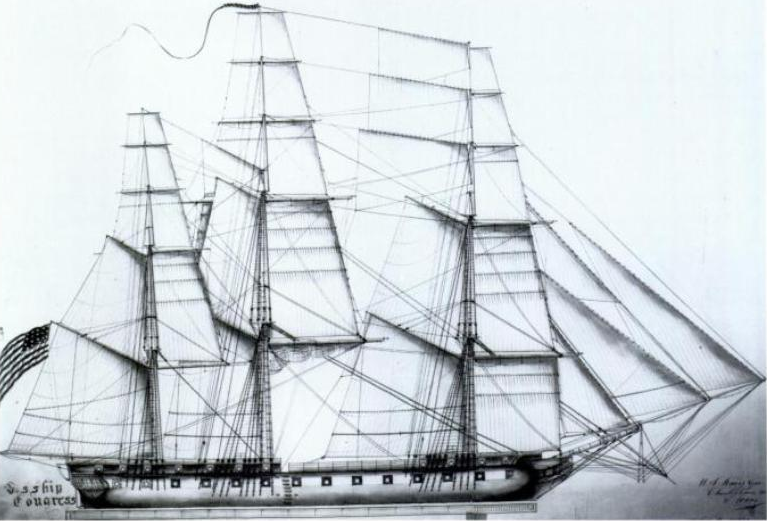
The USS Congress was a three-masted heavy frigate, one of the first six ships commissioned by the United States Navy, launched on August 15, 1799. Constructed at Portsmouth Naval Shipyard by James Hackett, she was designed under the principles of Joshua Humphreys, featuring a robust diagonal scantling hull that provided greater strength and durability than typical frigates of her era. Although nominally rated as a 38-gun frigate, she often carried up to 48 guns, reflecting her heavy armament and substantial size. Her length was approximately 164 feet, with a width of about 41 feet, and she was equipped with 18-pounder guns, consisting of a battery that varied during her service, including 28 18-pounders and 12 9-pounders during the Quasi-War. Her first voyage commenced in January 1800, after fitting out in Rhode Island. Early in her career, she suffered a dismasting during a gale, which resulted in the loss of all her masts but was repaired and returned to service. Initially tasked with protecting American merchant shipping during the Quasi-War with France, she later participated in the First Barbary War, patrolling the Mediterranean and engaging Barbary pirates. During the War of 1812, she made several extended cruises with her sister ship President, capturing or assisting in the capture of twenty British merchant ships before being placed in reserve due to material shortages. Throughout her service, USS Congress was notable for her versatility and extensive range of operations, including anti-piracy patrols in the West Indies, diplomatic missions to South America, and the first U.S. naval visit to China in the 1820s. She also played roles in blockades, patrols, and diplomatic negotiations during her career. Her design exemplified Humphreys' strategic intent to create a powerful, heavily armed frigate capable of overpowering typical enemy vessels and escaping larger ships of the line. After decades of active service, she ended her career as a receiving ship and was broken up in 1834, marking the end of an influential early period in American naval history.
This description has been generated using GPT-4.1-NANO based on the Vessel's wikidata information and then modified by ShipIndex.org staff.