
HMS Acheron
1930 A-class destroyer
Vessel Wikidata
* This information from Wikidata is available under the Creative Commons Attribution-ShareAlike License
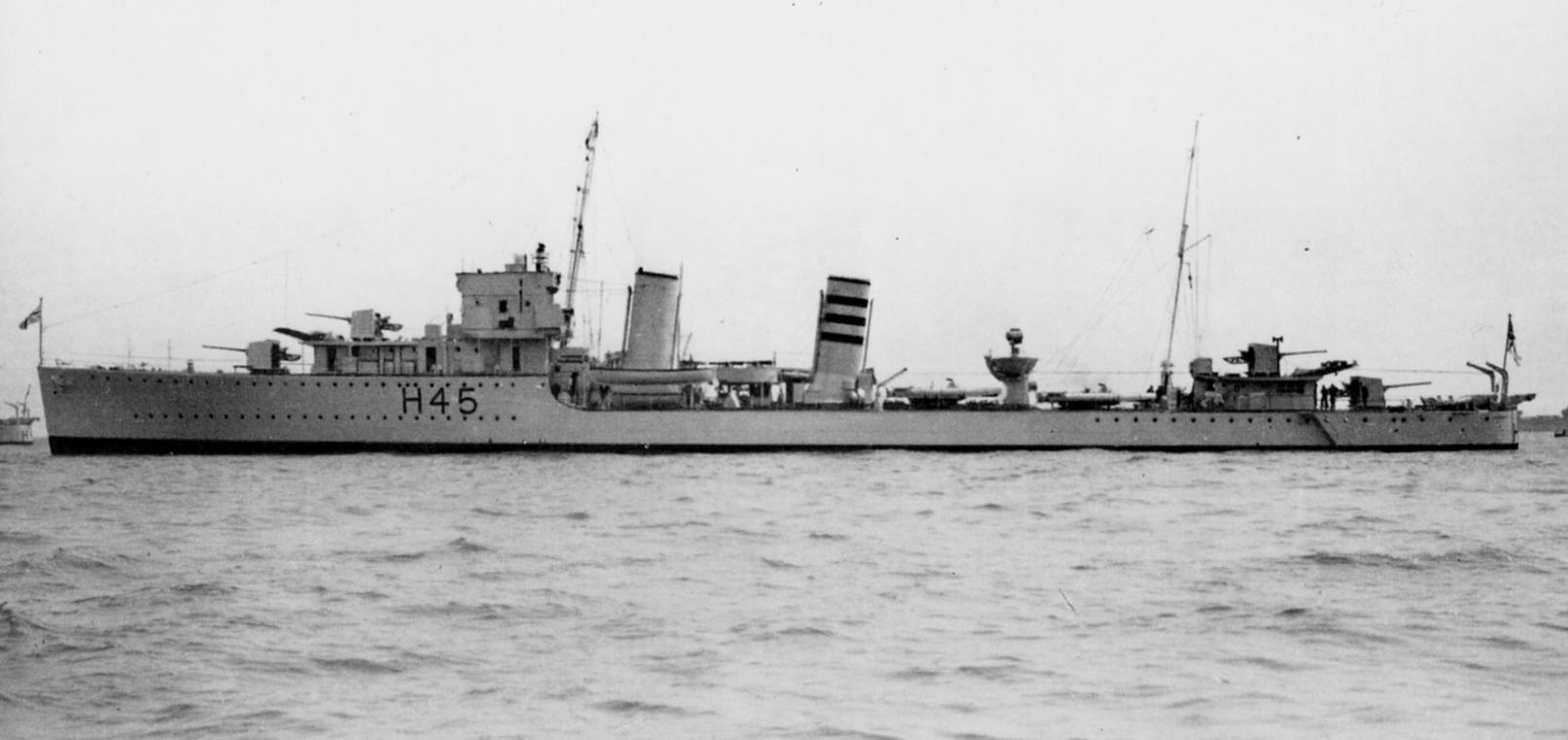
HMS Acheron was an A-class destroyer of the Royal Navy, constructed by John I. Thornycroft & Company at their Woolston shipyard in Hampshire. Launched on 18 March 1930 and commissioned in October 1931, she measured 323 feet (98.45 meters) in overall length, with a beam of 32 feet 3 inches (9.83 meters) and a mean draught of 12 feet 3 inches (3.73 meters). Displacing 1,350 long tons (1,370 tonnes) at standard load and up to 1,773 long tons (1,801 tonnes) at full load, Acheron was powered by three Thornycroft three-drum boilers feeding steam at 500 psi and 750°F to Parsons geared steam turbines rated at 34,000 shp, enabling her to reach speeds of 35.25 knots (40.56 mph). Her range was approximately 4,080 nautical miles at 15 knots, carrying 345 tons of oil. Her armament included four QF 4.7-inch (120 mm) Mk IX guns in superfiring pairs, two 40 mm QF 2-pounder Mk II autocannons, and four .303 inch (7.7 mm) machine guns. She was also fitted with two quadruple 21-inch (533 mm) torpedo tubes and was equipped with Two-Speed Destroyer Sweep minesweeping gear. Although space was available for ASDIC (sonar), it was not initially fitted. Her crew comprised 138 officers and ratings. Acheron’s service history included deployment with the British Mediterranean Fleet from 1932 to 1936, after which she returned to Britain for training and refits. Notably, she suffered from persistent mechanical problems owing to her experimental high-pressure machinery, which led the Admiralty to abandon similar experimental designs in later ships. During her wartime service, Acheron operated in Home waters and off Norway, participating in convoy escort, fleet screening, and troop landings during the Norwegian campaign. Tragically, Acheron was lost on 17 December 1940 after striking a mine off the Isle of Wight during steaming trials. The explosion caused her to catch fire and list heavily before sinking within minutes, resulting in 167 fatalities and only 19 survivors. Her wreck, located about 5 nautical miles south of St. Catherine’s Point, was designated a protected military site under the Protection of Military Remains Act in 2006. The vessel’s brief but active career underscores her role in the Royal Navy's early war efforts and her significance as an experimental yet resilient destroyer of the interwar period.
This description has been generated using GPT-4.1-NANO based on the Vessel's wikidata information and then modified by ShipIndex.org staff.