
Brother Jonathan
paddle steamer
Vessel Wikidata
* This information from Wikidata is available under the Creative Commons Attribution-ShareAlike License
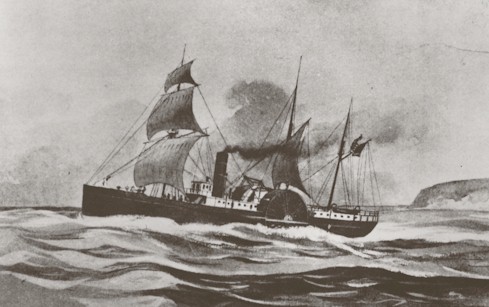
The Brother Jonathan was a notable paddle steamer launched on November 2, 1850, built by Perrine, Patterson, and Stack in Williamsburg, Brooklyn. Measuring approximately 220 feet 11 inches (67.34 meters) in length and 36 feet (11 meters) in width, the vessel was initially commissioned to serve routes during the California Gold Rush, running from New York to Chagres, Panama. On its first voyage in 1851, it set a record for the fastest round-trip at 31 days, facilitating passenger transit across the Isthmus of Panama. In 1852, the ship was acquired by Cornelius Vanderbilt, who modified it to carry more passengers for Pacific routes. Vanderbilt operated the vessel around Cape Horn, expanding its service to the west coast, including from San Francisco to British Columbia during the Fraser Canyon Gold Rush. After falling into disrepair in 1861, the vessel was sold to the California Steam Navigation Company, which restored its name to Brother Jonathan. It then gained a reputation as one of the fastest steamers on the Pacific Coast, completing trips in about 69 hours each way. Throughout its service, Brother Jonathan played a significant historical role, notably in delivering Oregon’s statehood news to Portland in 1859. Its voyages also inadvertently contributed to the 1862 smallpox epidemic in the Pacific Northwest, as infected passengers brought the disease ashore, resulting in the deaths of thousands of Indigenous people. The ship’s final voyage occurred on July 30, 1865, when it struck an uncharted rock near Point St. George after encountering stormy seas. The collision tore a large hole in the hull, which was further compromised by a cargo of heavy ore crushers. Despite having enough lifeboats, rough seas capsized several, and only one lifeboat with 19 survivors escaped the sinking. The ship was carrying a substantial cargo of gold, including coins, bars, and valuables worth an estimated $50 million today, but the wreck was not located until 1993. In 1996, divers recovered numerous artifacts and nearly 900 gold coins, with significant legal battles over ownership and salvage rights. The wreck, lying approximately 8 miles from Crescent City, California, remains a site of archaeological and historical significance, with many artifacts, including the ship’s wheel, exhibited locally. The loss of Brother Jonathan marked a pivotal event in maritime history, prompting safety reforms and a memorial at Crescent City designated as California Historical Landmark No. 541. Its listing on the National Register of Historic Places underscores its enduring historical importance.
This description has been generated using GPT-4.1-NANO based on the Vessel's wikidata information and then modified by ShipIndex.org staff.