
HMT Cameronia
ship
Vessel Wikidata
* This information from Wikidata is available under the Creative Commons Attribution-ShareAlike License
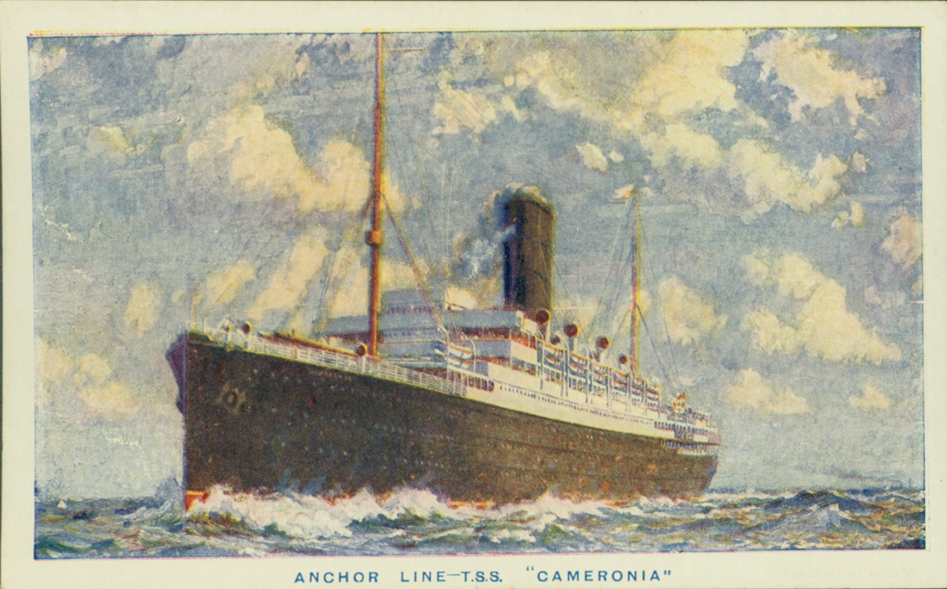
The RMS Cameronia was a British ocean liner constructed in 1920 by William Beardmore & Co Ltd in Dalmuir, with yard number 584. Launched on December 23, 1919, and completed by September 1920, she measured approximately 552 feet 4 inches (168.35 meters) in length, with a beam of 70 feet 4 inches (21.44 meters) and a depth of 38 feet 8 inches (11.79 meters). Her gross registered tonnage was 16,297 GRT, with a net tonnage of 9,607 NRT. Powered by six Beardmore-built steam turbines, configured in double reduction gearing and driving twin screw propellers, she could reach speeds of up to 16 knots (30 km/h). Cameronia served as an ocean liner for the Anchor Line, owned by Cunard Line, and was a sister ship to RMS Lancastria. She was initially designed to carry a total of 265 first-class, 370 second-class, and 1,100 third-class passengers. Her maiden voyage departed from Glasgow to Liverpool and New York on May 11, 1921. Throughout her early years, she underwent several refits, including significant modifications to her passenger accommodations and stability improvements following issues with pitching. Notable early events include rescuing the crew of a US Coast Guard cutter in 1925 and surviving collisions, such as with the Norwegian steamship Hauk and Cunard’s Samaria. During the 1930s, she was laid up briefly on the Clyde and changed ownership when the Anchor Line went into liquidation. Recommissioned as a troopship in 1935, Cameronia participated in the 1937 Spithead Naval Review as a floating grandstand. During World War II, she was requisitioned as a troopship, notably participating in evacuations during the Battle of Crete, where she evacuated 6,000 soldiers. She was torpedoed on December 22, 1942, off Algiers but managed to reach port for repairs. She also played a significant role in the Allied invasion of French North Africa and served in the Mediterranean, including in Operation Overlord in June 1944, where she was the largest troopship involved. After the war, she returned to trooping duties, including transporting emigrants to Australia. In 1953, she was renamed Empire Clyde under the Ministry of Transport and continued service until 1957, when she was scrapped at Newport, Monmouthshire. The RMS Cameronia remains notable for her extensive wartime service, her role in transatlantic passenger travel, and her appearance in British cultural references such as Downton Abbey.
This description has been generated using GPT-4.1-NANO based on the Vessel's wikidata information and then modified by ShipIndex.org staff.