
HMAS Australia
1927 Kent-class heavy cruiser
Vessel Wikidata
* This information from Wikidata is available under the Creative Commons Attribution-ShareAlike License
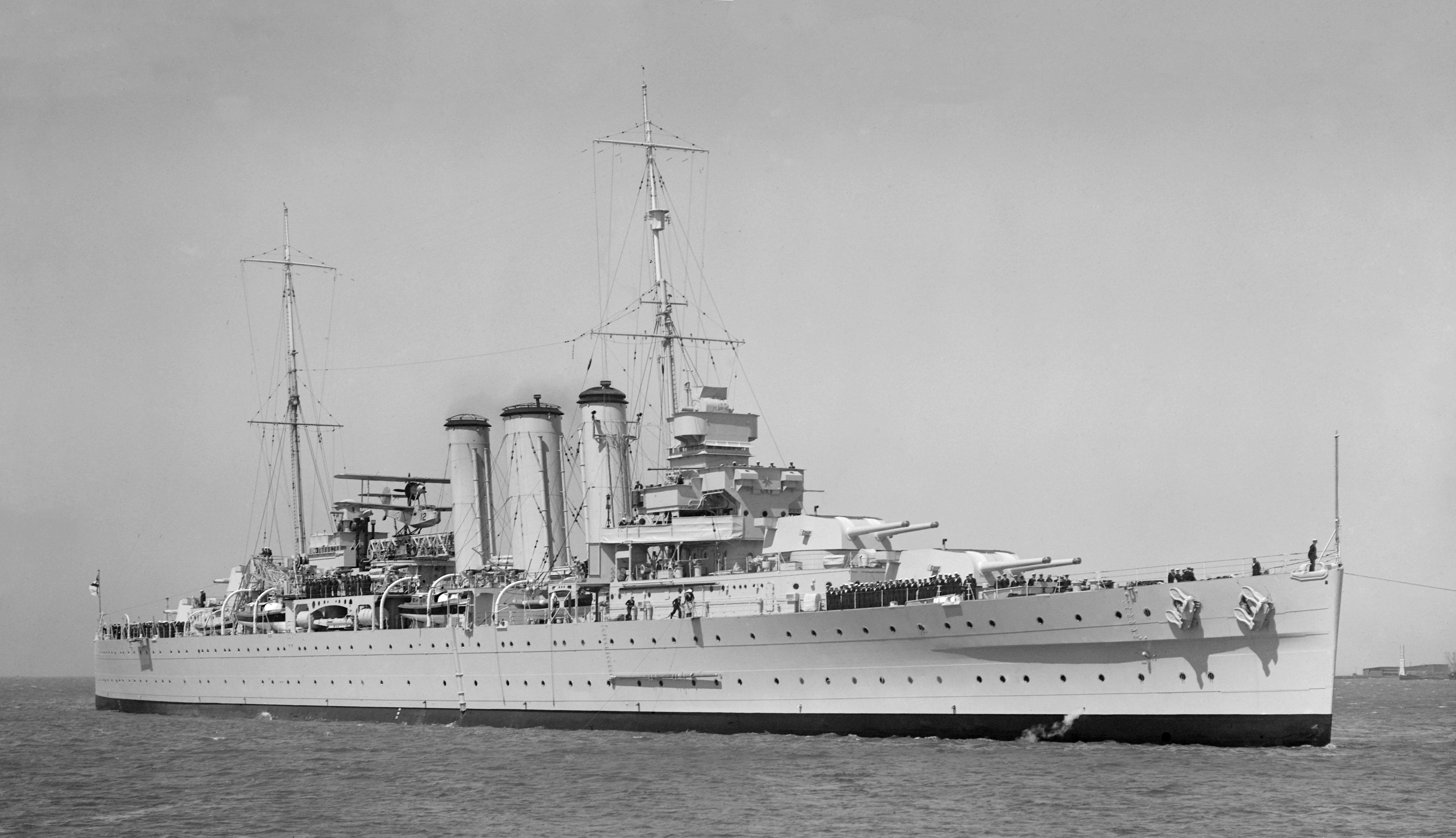
HMAS Australia (I84/D84/C01) was a County-class heavy cruiser of the Royal Australian Navy, representing a significant component of Australia's naval forces during the mid-20th century. Built to the Kent-subclass design, she was one of seven County-class cruisers constructed based on the work of Eustace Tennyson-d'Eyncourt. Laid down in 1925 by John Brown and Company in Clydebank, Scotland, she was launched on 17 March 1927 and commissioned into the RAN on 24 April 1928. She measured approximately 630 feet overall in length, with a beam of 68 feet 3 inches and a maximum draught of 21 feet 4 inches. Her propulsion system comprised eight Yarrow superheated boilers feeding Curtis high-pressure and Parsons low-pressure turbines, producing up to 80,000 shaft horsepower to four propellers, enabling a top speed of 31 knots. Her range was approximately 2,270 nautical miles at 11 knots, with a cruising endurance of 10,000 nautical miles. Her primary armament consisted of eight 8-inch (200 mm) guns in four twin turrets, supplemented by secondary armament including four 4-inch guns (later upgraded to twin mountings), anti-aircraft weapons such as 2-pounder pom-poms, and multiple machine guns. She was also fitted with two sets of quadruple 21-inch torpedo tubes, which were removed in 1942. During her wartime service, her close-range AA defenses were progressively modernized, replacing older machine guns with Oerlikons and Bofors guns. She carried a Supermarine Walrus aircraft, operated via a catapult installed in 1935, which was removed in 1944. Commissioned in 1928, HMAS Australia participated in various deployments, including an exchange tour to the Mediterranean and operations around Australia and the South-West Pacific. During World War II, she served extensively in both European waters and the Pacific theater. Notably, she was involved in the Battle of the Coral Sea, the Battle of Savo Island, and supported the Guadalcanal and Leyte Gulf campaigns. She faced kamikaze attacks in 1945, sustaining casualties and damage but continuing her operational role. Her service earned her eight battle honors, reflecting her extensive combat record. After the war, she served with the British Commonwealth Occupation Force in Japan, and later as a training ship. Decommissioned in 1954 after 26 years of service—the longest for an RAN warship at that time—she was sold for scrapping in 1955 and dismantled in 1956. Her legacy includes a memorial and an 8-inch gun barrel on display at the Australian War Memorial, commemorating her significant contribution to Australia's naval history.
This description has been generated using GPT-4.1-NANO based on the Vessel's wikidata information and then modified by ShipIndex.org staff.