
SS Canberra
ocean liner built in 1961
Vessel Wikidata
* This information from Wikidata is available under the Creative Commons Attribution-ShareAlike License
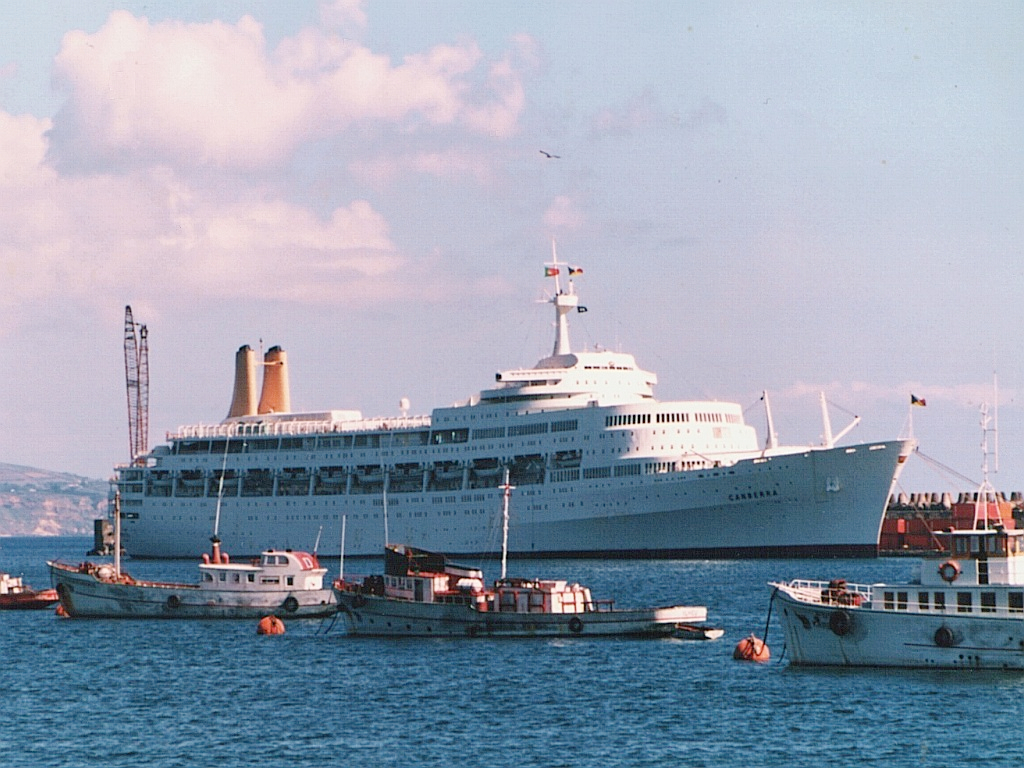
The SS Canberra was a notable ocean liner operated by P&O from 1961 to 1997, distinguished by its impressive specifications and versatile service history. Built at the Harland and Wolff shipyard in Belfast, Northern Ireland, she was the last ocean liner constructed by the yard and the largest since the HMHS Britannic. Her construction cost was approximately £17 million. Launched on 16 March 1960 and christened by Dame Pattie Menzies, she officially entered service in May 1961, with her maiden voyage commencing in June of that year. Measuring 819 feet (250 meters) in length with a beam of 103 feet (31 meters), she had a gross tonnage of 45,733 GRT. Her propulsion system featured turbo-electric transmission—an innovative design at the time—driving twin propellers with a combined power output of about 42,500 horsepower per shaft, allowing her to reach speeds around 27.25 knots (50.5 km/h). She also had a bow propeller for maneuvering and was the first British passenger liner to operate on alternating current power. Designed primarily to serve the UK–Australia route, Canberra could carry 548 first-class and 1,650 tourist-class passengers. Her elegant interiors included notable features such as an Australian walnut spiral staircase, the William Fawcett reading room, and a 'Cricketers Tavern'. During her early years, she made regular voyages through the Suez Canal, calling at ports like Colombo, Fremantle, Melbourne, Sydney, Auckland, Honolulu, and Los Angeles. In 1972, she was refitted from an ocean liner to a cruise ship, with minimal internal alterations, and accommodated around 1,500 single-class passengers. Her distinctive design included a bulbous bow, side-by-side funnels, and recessed glass-fibre lifeboats for improved passenger views. Notably, she played a significant role during the Falklands War in 1982, requisitioned as a troopship to transport British forces to the South Atlantic, earning the nickname "Great White Whale" due to her white hull and size. She participated in the landings at San Carlos Water and later served in repatriation efforts. After her military service, Canberra resumed her cruising career, maintaining public affection and recognition. However, rising operational costs and the expense of complying with modern safety regulations led to her retirement. She was withdrawn in 1997, sold for scrap, and dismantled at Gadani, Pakistan, by the end of 1998. Her legendary status remains in maritime history as a symbol of the transition from the golden age of ocean liners to modern cruising vessels.
This description has been generated using GPT-4.1-NANO based on the Vessel's wikidata information and then modified by ShipIndex.org staff.